Kitchen Garden Guides

Showing posts with label blogs. Show all posts

Friday, June 4, 2021

June 2013 Kitchen garden Guide


Winter has not quite set in, allowing extra time for gardening in mild temperatures and mostly sunny days. I have been busy sheet mulching. I have several shrubbed areas I’d like to keep more or less grass free to reduce maintenance so here is what I do.

1.   More or less cut the grass and weeds as low as possible. Leave them on the surface.

2.   Throw over any vegetable scraps (even fresh), lawn clippings, plant clippings and soft prunings, mushroom compost, blood and bone.

3.   Completely and thoroughly cover it all with cardboard. Dampen down. Don’t worry too much about some sticky tape or coloured labels but I don’t use the shiny cardboard as it can take ages for water to get into it.

4.   Next put old manures to hold down the cardboard. Dampen again.

5.   Lastly cover with as much straw or other weed-free mulch as you can afford; 20 cms is good. Make it really dense and not too fluffy or you will soon see the cardboard.

6.   Grab a cup of coffee, pull up a seat, smile and survey your work!

If you want to use a similar method in your herb garden or perennial vegetable area, use newspaper instead of cardboard, as it is easier to get it around smaller plants. Lay it 10 sheets thick and generously overlapped.

If you want to make a new vegetable garden bed, then, after mowing the grass and weeds down, sprinkle the ground generously with lime before following the cardboard or newspaper method.

Winter herbs for health and flavour

Do you love pesto and lament the end of fresh basil from your garden? Well I make a wonderful pesto with chervil and almonds / tarragon and pistachios / parsley and walnuts.

There are so many lovely herbs that either grow and thrive only in winter or continue to hold their colour and flavour even in winter. The former includes the slightly aniseed chervil, with its pretty, soft ferny leaves which I grow as a block and clip by the handful, with scissors. Also in this category is coriander with its robust flavour and growth habit. A less well known and often misunderstood winter herb is angelica, with a pine-like aroma in its large, fern-like leaves. No need to bother with the stems which are traditionally candied, simply chop up the leaves and use them finely sliced with fruit or to line the bottom of a cake tin before baking. Parsley is a fabulous winter herb, readily self-sows and is useful all through winter in meals and as a wonderful source of vitamin C, in our climate where oranges are rare.

Interestingly, all these are members of the Umbelliferae or carrot family. The family also includes asafoetida, caraway, cumin, dill and lovage, to name a few.

Rocket is another herb that germinates and thrives during winter.

Herbs that hold their colour and flavour even in winter include rosemary, thyme, oregano, marjoram, winter savory, bay and sage, although sage should be picked sparingly as it is much less vigorous in winter.

Community Help Needed

Some of us have secured the rather lovely job of revamping the Cygnet Library garden and over the next few months will be bringing life, colour and some edibles to the small, front beds.

In order to get something cheerful into the soil for winter we are asking for any donations of small flowering plants and herbs of a good size. If you can help with donations, please email me katevag@gmail.com or speak to the library staff.

As time goes on we hope to introduce signs and gardening tips as part of the library’s education arm, encouraging everyone to learn and enjoy plants in their lives. Hopefully we will be allowed to extend our plans right the way around the library and incorporate many Tasmanian plants, edible and ornamental as well as local art projects.

Bushfire Gardens

Thank you so much to those who kindly donated an amazing array of garden-related goods. They have now been delivered and I have been asked to express gratitude by the gardeners in need. Please keep donating, but only garden goodies please, to 4 Winns Road, Cygnet, behind my letterbox.


Books for winter reading

Vegetable Literacy by Deborah Madison (A mammoth book of every vegetable and herb imaginable – includes history, geography, culture and cooking)

The Great Herb Tour by Christina Hindhaugh (A delightful true story of travelling the world in search of herbs and gardeners).


Blogs and websites for indoor enjoyment

www.goldenvalleyfarm.net – Alex Taylor’s adventures as a market gardener including his new DIY movable cloche/poly tunnel system

ABC Landline 26/05/2013 : Sailing to Market – a superb video of the Olive May’s recent trip down the Huon, collecting produce to take to Salamanca market.

The Preserving Patch – a Tasmanian blog all about preserving, by Sue who lives in the north west (thepreservingpatch.blogspot.com.au)


Seeds to sow in June

Sow in the garden:

Broad beans

Salad and spring onions

Shallots

Chives

English spinach

Radishes

Plant out

Garlic

Asparagus crowns

Divide rhubarb

Winter herbs

Winter flower annuals

Globe artichokes

Sunchokes

Bulbs


Sow in trays:

Brassicas

Artichokes

Coriander

Chervil

Lettuce

Rocket

Asian greens

Jobs for June

Prune deciduous trees except cherries and apricots

Feed and mulch the dripline of fruit trees with anything you have, including seaweed.

Collect seaweed (especially kelp) after winter storms and cover your asparagus patch with it. Brassicas also love it. Wonderful added to your compost too.

June 2012 Kitchen Garden Guide


Sitting on my verandah writing this in the glorious winter sunshine is one of the benefits of living in southern Tasmania. By this I mean that we do, actually, have a lot of sunshine, on and off, all year round.

I read a very interesting book by Eliot Coleman, an organic, American market gardener, called…… In it he describes his trip through Europe following the same latitude at his property in Maine, USA. In the USA, in fields of snow, huge commercial poly tunnels are heated artificially in order to produce all year round tomatoes and other, out of season vegetables, totally ignoring the diversity of winter vegetables. In this trip, he is seeking knowledge on growing seasonal food all year round in climates similar to his own; colder than Tasmania but with similar levels of winter light.  

The book is well written and rich with anecdotes of speaking to farmers in their fields and gardeners in their potagers, through France, mostly. What he discovers is that the growth of plants through winter is more about the amount of light available than about heat. The answer to maintaining plant growth throughout winter in low light latitudes is to simply ensure that the plants have developed a large surface area of leaf by late autumn, when the sunlight hours become very short. Then, only pick ½ the amount of leaves you would pick at any one time in summer, so that the plants large solar surface area is maintained throughout winter.

As winter storms in the roaring 40’s send high seas crashing onto the shores of Tasmania, kelp and other sea plants are strewn on the beaches. Peter Cundall recently said on the radio that we are allowed to collect seaweed from most beaches at the rate of 100kg / day. Seaweed is heavy, so that is not as much as it sounds. I have some great ideas for using it! Seaweed contains trace elements which we often neglect to think about in our food gardens.

1.    Place tubs or large buckets here and there in your garden. Half fill them with seaweed and fill to the top with water. Cover if you like. Keep a ladle nearby. Whenever you see some plants looking a bit weak or off-colour give them a tonic of 1 part seaweed water to 9 parts water, in a watering can. Pour over the leaves.

2.    Completely cover your asparagus patch with a thick layer of seaweed during winter. Leave the rain and the worms to do the work.

3.    Seaweed is a wonderful addition to mulch under fruit trees.

Recently I was helping a friend prune some of her enormous red, black and white currant bushes. Hungrily, I gathered up all the sticks and just fitted them all into the back of my car (yes, there really were THAT many!). I took them to the Cygnet Community Garden where we will turn them into smaller bundles of cuttings to sell at the market and raise a bit of money for ongoing projects. If you’d like some, come to the Cygnet Market 1st and 3rd Sundays in the Town Hall. Even better, come and help us tie them into bundles in the community garden on Tuesdays from 9.30am, and get some for free!

Sharing is easy; the Cygnet Market has a community stall where anyone can take excess produce to sell. You can stay and help or just leave them and come back later for your money! Being part of a community is a very rewarding experience.

This month I would like to introduce you to another of my blogger friends, Pattie Baker, who lives in Atlanta, Georgia, USA. Ten or so years ago Pattie was a regular American consumer. Then the Towers fell and many Americans re-evaluated their lives. Pattie decided to grow food, for her daughters, and so began the family’s incredible journey. Now Pattie is an advocate for sustainability, a community leader in urban food production and gives corporations advice on becoming green citizens. She calls it “local action/global traction”.  Visit her at foodshedplanet.com. She has also written a book, from the heart, called Food for my Daughters. I highly recommend it.

Sow now in the garden:

Onions (Creamgold, Domenica Sweet), broad beans, green manures

Sow now in the hothouse or outside in frost free areas:

Coriander, miners’ lettuce, spring onions, Asian greens, lettuce, bok choy, sugar snap peas,

Sow now to transplant  later:

Broccoli, red cabbage, kales

Also:

Divide rhubarb and globe artichokes. Lime and mulch fruit trees. Prune berries, currants and gooseberries. Take cuttings of deciduous plants. Plant kiwi fruit and be sure to get a male and a female plant. They like sun, a rich, acidic soil and good drainage. Kiwi fruit vines require a strong trellis or pergola and are frost hardy once established. Fruit ripens in winter which is just when we need them!


Tip of the month:

Rub all the wooden handles of your tools with linseed oil. Keep an oiled cloth with your garden tools and rub them over several times during winter. Clean secateurs and other blades with dry steel wool. Spray with lubricant or wipe with the oiled cloth. You’ll be amazed at the difference it makes!

Friday, May 18, 2018

Rekindling the spirit within

It is only weeks until I hand over my little wholefoods business to new blood. Tiny though it is, its creation and success has been in no small part due to my intensive commitment to sourcing organic, Australian ingredients from individual farmers and makers as well as the individual needs of my customers. The time involved in doing so has meant my head has had little room for the finer workings of my food garden and its seasonal systems.

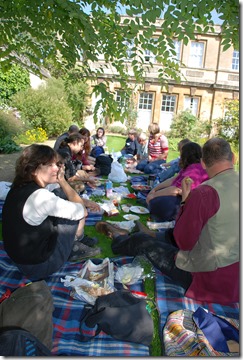
Last night I began reading some of the food gardening blogs in the side bar here and it has sparked a firecracker reaction in my heart and head to sow and plant all manner of interesting edible plants again. Maybe it will happen that I reconnect with old food gardening bloggers as well as find new ones, from far corners of our planet. Facebook has not taken them all away and turned them into clickers and likers; they are still there, writing and sharing their experiences to any who choose to come by. Below are the food gardening bloggers who gathered at the Oxford Botanic Gardens in 2008. None of us had ever met before but we had all read each others blogs.

DSC_0014  Bloggers gathering at Oxford Botanic Gardens, 2008

As winter creeps in and my head loosens its ties to being a wholefoods sole-trader the spaces will be filled with the inner warmth that comes with sorting and sourcing seeds, reading and writing about food gardening and planning for more nooks in my garden, to grow unusual vegetables. I look forward to working in the cold, misty, winter garden, rugged up and conscious of the life there; in the soil, in the trees, in the pond and in the sky.

My house is full of books about growing and cooking. During these past 8 years I have not stopped buying and reading them. Now the future will be about the doing and the eating and the sharing and the pure joy of it all.

Life is good and I am almost there…..

Tuesday, July 7, 2015

Fast and Slow; writing and typing, gardening and thinking…

It is so frustrating, to say the least, this whole facebook thing. I love writing and I have loved reading people’s blogs for years but now we seem to be losing our blogger community because more and more people, including myself, are following others on facebook, where everyone shares what a few write, instead of everyone writing. It is like civilisation in general; slow and thoughtful is losing ground to fast and mindless. Reading a whole article has given way to “liking” a few words on a poster or a photo.

Several readers of my local newspaper gardening column have commented that they liked this month’s piece. In it I urged all winter gardeners to…..

Relax… enjoy crunchy morning frosts as you head out to feed the chooks, the cloud sitting low across the hills and mountains, the quiet, silver waterways with their boat reflections, steamy cafĂ© windows, early darkness meaning time to cook, time to enjoy company by the fire and time to read, to blog and indulge your mind.

So here I am, in bed at 6am, writing, before the sun is up to interrupt my thoughts. I have a friend who achieves more in her day than I do in a week. I seem to spend quite a bit of time leaning on my spade, so to speak, thinking. Facebook is wonderful at stretching your boundaries, offering new and exciting areas of life, science and the garden from near and far. These snippets follow me around and make me think but often mean I am not focused on what I should be doing.

It is quite ironic, this conundrum; that the fast scrolling of facebook that stimulates my mind, slows the rest of my brain and consequently I get less done. Does it matter? I love learning of new things; of all the things I enjoy, new ideas and their possibilities would probably be leader of the pack. I imagine a future when everyone embraces sustainable living and new ways of running the economy, the country, the world, that benefits humanity and the earth as a whole and is not so self-indulgent as the current system.

Grammar is tricky…. theoretically that last sentence should read….I imagine a future when everyone embraces sustainable living and new ways of running the economy, the country, the world, that benefit humanity and the earth as a whole and are not so self-indulgent as the current system. But I think there will be new ways but only one system, in the end, that takes the place of the current one so I kept the singular. There is a facebook page I like called “Grammarly” where such things are discussed.

Grammar is going the way of handwriting skills; into history. Both are necessary for communication in any era, I think. Why handwriting, you ask? Well, learning to write with a pencil brings art to the written word and is a wonderful extra means of expression. It is like a scented garden compared to a visual-only one. I look forward to the day when I can write here, instead of type, and we can know a little more of the person than just their words. Then we’d see our crossing outs, vocabulary alterations and how our handwriting changes with age, seasons, time of day, available light etc. It seems that these days the main writing I do is shopping lists, sums in my shop and notes to remind me to do things like hang out the washing, turn off the sprinkler etc.

Our Cygnet Community Garden group has taken over the recipe blog I started for a previous group in Adelaide. There we are going to put the recipes for the delicious things people cook for our shared lunch after the work on Thursdays, at the community garden. It is called Gardeners’ Gastronomy.

It is cold this morning and my hands are telling me it is time to get up and move, go out by the fire and warm up. I will stand, check the various containers on my mantle-piece, full of sprouts and ferments, and think a little, before launching into my day. No-one much will read this, even though it gets posted to my facebook page, because it has no photos to capture an audience.

Thursday, September 5, 2013

Early Spring Pasta Bake…. from the garden

I have a wonderful book called ‘Vegetables from an Italian Garden’ and I have a wonderful vegetable garden from which to cook. The book is so different to any other vegetable book I know; it is very hard to explain why, except that the recipes for each vegetable are simple, always delicious, made for gardeners and not full of cheese, tomato paste and pasta. It also is about growing the vegetables and is arranged by season.

On Tuesdays I cook some meals for a busy, local family. They collect a range of vegetarian things from my home; always including some soup, mains, patties, bread and salads which I make with vegetables from my garden whenever I can. I make enough of each dish for me as well which saves me cooking for a couple of nights.

They love a big baked pasta dish, full of cheese, to feed the hungry teenagers. But I am not so keen on this, so this week I adapted it to my tastes and baked mine in a separate dish. I have some beautiful, voluptuous fennel bulbs in my garden at the moment which will bolt soon so now is the time to use them.

The fennel filling part of the recipe was inspired by the book I mentioned, which has several lovely recipes for fennel bulbs. I didn’t know it was going to be sooooo delicious and did not take photos but, anyway, it doesn’t look that exciting!

This is what I did for my version but is enough for a large lasagne dish. There is more explanation at the bottom. I am so hopeless!!:

  • Top and tail 3 large fennel bulbs, making sure they are free from slugs if they are from your garden like mine were!
  • Bring a large pot of water to the boil. Put the fennel bulbs in and simmer 30 minutes. Drain but reserve the liquid. Slice the fennel thinly when cool enough to handle.
  • At the same time bring another pan of water to the boil and cook plenty of good quality pasta, eg fettuccine, orecchiette, penne or other.
  • Hard boil 3 eggs. Peel and carefully slice into quarters.
  • Chop 2 or 3 stems of fresh spring garlic stems, all of them, from bottom to the top of the greens. Or, if you have garlic bulbs, crush and chop several cloves.
  • Chop up a good handful of greens, such as mizuna, silver beet etc
  • Chop up some mushrooms if you have them but ok to omit.
  • Make a green peppercorn sauce, using some of the fennel cooking water. Make it runnier than my recipe on that link.
  • Have some grated cheese at hand for the top…. Just a little, don’t drown out the subtle flavours of this dish with too much cheese!

When you are ready, just assemble the layers into a large baking dish:

  • first start with a drizzle of the peppercorn sauce
  • then half of the pasta.
  • next, half the sliced fennel bulbs, eggs, mushrooms, greens, garlic
  • then half the peppercorn sauce
  • repeat and sprinkle the top with a good cheese but not too much
  • pour 1/2 cup or more of water around the edges

Bake 160C for 20 minutes until just beginning to colour a little. You don’t want it all dark and crisp like you do with a tomatoey lasagne.

***Actually, I made mine in a single serve soufflĂ© dish, and only had 1 layer. For the big one I made for the family I used 1/2 the green peppercorn sauce recipe and put that in the middle but for the top I mixed 2 eggs and a fair bit of yoghurt, poured than over and then grated cheese onto it. But if you don’t have home made yoghurt or your own chooks, then the peppercorn sauce on top would be fine…. I eat it by the spoonful.***

Monday, August 5, 2013

Inner Transition, the next stage of CIVIL-isation

Many towns and villages in the UK are already well progressed in their transition endeavours. You can explore the fabulous world of Totnes and Incredible Edible Todmorden, where whole populations have embraced a change of lifestyle which will enable every one of them to live comfortably and participate fully in a world with less stuff and more connections.

But what happens inside people when their external lives are transitioning? What internal state do we need to achieve in order to even begin contemplating transitioning? How do those who are ready help those who are not, to get ready? Is there something inside us, beyond transition, that will help us maintain and adapt, into the future?

These are some of the questions now being explored in some of the more advanced transition towns of the UK, in particular by a woman called Sophy Banks.

People who are stressed or displaced or faced with trauma all display a similar range of characteristics. This has been known for a hundred years or more. What is disturbing is that research shows that a great number of people worldwide are showing these symptoms even though their lives are not typical cases. It seems that just living a consumer lifestyle and working for a large corporation brings out the fight or flight mode in many people; making them defensive and argumentative. Moreover and even more worrying to me, is that when people are in this hectic lifestyle situation, their brains are actually incapable of broadening and their range of thoughts actually shrink. Decisions and opinions become black and white and their focus narrows.

For any change to happen peacefully, creatively and quickly people need to be open to all ideas, able to discuss and converse without animosity and to be able to see beyond today and themselves, to the future for humanity and the earth. The longer it is before the majority of people are participating in transition movements, the harder it will be to get the attention of those people still at the narrow, protective, argumentative, power-hungry stage. Their brains simply will not accept anything outside what they already have to deal with and they often feel threatened and unable to take action (which sadly seems to include members of most governments, who increasing are behaving in a very uncivil manner and refusing to take much needed action).

I think inner transition is akin to the Dalai Lama’s notion of inner peace and to the calm of meditation. When your brain ceases to be full of anxiety, worry, trauma and anger it is like a sponge, ready to soak up new ideas, ready to look outward and you are then ready to put your shoulder to a good cause. When the good cause actually reduces your stresses and makes you feel happy with your future, it is a win:win situation.

Life is good; get there fast then take it slow…. and don’t argue with those who say otherwise!

Sunday, June 9, 2013

Portable Vegetable Garden Structures at Golden Valley Farm

Alex is our local market gardener…. with a difference! He used to be a chef at Parliament House in Canberra, has studied all kinds of interesting things at uni. and has gone into this market garden idea with his eyes wide open and with a plan to make the business work, for his young family.

Picture

For a start he and his wife bought the perfect piece of land just a 30 minute walk from the main street of Cygnet, in Golden Valley; gently sloping, north-facing, with good soil, 2 spring fed dams and quite a distance from any native bush (so very few animal problems).

They built a pretty, little house and turned a tiny little shed into a 1/2 glass, 1/2 solid, seedling house. Then Alex baled up the hay cut from his land in summer and put the bales side by side and end to end to make a rectangle of covered grass, using up all the bales. In spring he removed the bales, hoed the soil and began to sow the seeds of his new life.

He and I have a similar philosophy about organic food production; which includes NOT using massive amounts of plastic for poly tunnels. But rather, using what you have in the way of climate to produce seasonal, organic food.

Sometimes, at this time of year, young seedlings need a bit of extra warmth to get going because the soil is already very cold. So, Alex has made some movable cloches, sized to fit his beds. On his blog Golden Valley Farm you can find all the instructions to make your own.

Picture

As he mentions in his post, the plastic can be removed in summer and the frame fitted with netting to keep off the cabbage moths, or shade cloth to protect young seedlings from the heat.

image


So, when you see a beaming Alex at his stall at the Cygnet Market, remember he is the most genuinely organic farmer around and that he was up before dawn, picking vegetables for you to buy.

Never, ever think that his prices are more than his produce is worth!!

Picture

Thursday, May 23, 2013

Tasmania in winter….

View from Waterfall’s Cafe, Mt. Field National Park, Tasmania…. so, why wouldn’t you come to Tasmania in winter?

Photo: WARNING... Images may INSPIRE!!<br /><br />To celebrate the launch of Waterfalls Gallery on the 1st June I'll be sharing some seriously amazing images to entice you all to come and visit us here at Waterfalls Cafe Mt Field National Park.<br /><br />How could you not be inspired by the Tarn Shelf here at Mount Field?

And the hills are alive….. with peace, and green and cosy fires….

(from Discover Tasmania)

Photo: A picture perfect morning in Deloraine. Almost makes you want to jump in and go for a swim...

And Tuesday Soup Nights at the Red Velvet Lounge in Cygnet…. free and warm and welcoming…. Thanks Steve!

Monday, May 20, 2013

Foraging Workshop at Birchs Bay

Channel Living with Paulette Whitney
Saturday the 1st of June             10am until 12:00 noon
 
Take this opportunity to learn more about the edible plants, both native and introduced, that are growing all around you.  Paulette Whitney will share her extensive knowledge of these plants in a foraging field trip at Birchs Bay.

Paulette, a qualified horticulturalist, and her husband run their business Provenance Growers they supply many innovative restaurants and have a regular stall at the Farm Gate Market, where they share their passion for utilising little appreciated plants.
According to Paulette;
‘Foraging refers to the gathering of wild grown food, rather than intentionally raising and harvesting it.  It enables new and intense flavours to find their way onto our plates, and forgotten foods to be rediscovered.  Traditional Tasmanian foods give us a window into our history, help to humanise Tasmania’s past.  Weeds, prepared artfully to reveal their innate deliciousness and to allow us to enjoy their nutritional benefits, are fabulous foraged foods.’
 
An excerpt from Paulette’s blog; Provenance Growers where she shares some of her knowledge and experience with Grey Saltbush.
 
Grey Saltbush, or Atriplex cinerea, is in the goosefoot family, Chenopdiaceae, along with lots of other valuable edibles; silverbeet, beetroot, quinoa and spinach. Even closer edible allies share its genus, Atriplex, which includes orach and fat hen.
I can't find many references to Aboriginal uses of it, please tell us if you know any more, but in the early days of white settlement it was depended upon as a vegetable. From what I can gather of its history of use, there was a terrible famine in Tasmania when supply ships failed to arrive. Grey Saltbush took on great importance as a famine food. It was eaten boiled, and it is still recommended today that it be cooked before eating.
The most delicious use it has been put to in my kitchen was to as a covering for a leg of lamb. I'd put the lamb in too hot an oven, and placed a bunch of saltbush on top of it to protect it while it cooked. A great example of necessity being the mother of invention, we threw away the sprigs on top that were burnt, and underneath found the most delicious leaves that had soaked up a little lamb fat, and had become like crispy, lambey, vegetabley potato crisps.
 
Cost: $25 children free
Plus Channel Living Membership if not a member: $12 single or $20 per family
(All participants must be members of Channel Living to be covered by our insurance)
Email: workshops@channelliving.org.au to register or
Phone Cath Earnshaw 62921032 for more information

Limited numbers
 
What to Bring:
·         Photos or examples of plants that you would like identified (extensive range of reference books available for plant identification)
·         Water for drinking
·         Warm work clothes
·         Sturdy boots or gumboots and gloves

Friday, May 10, 2013

The TV segment and my interview with Gavin

It was great to talk with Gavin from the Greening of Gavin. Gavin is a star of sustainability and has written various ebooks about cheese making, cob oven building  and all sorts of green and wonderful projects and ideas. He lives by his words and manages to have chooks, fruit trees and vegetables as well as an impressive solar power station on his tiny suburban block in Melton, Vic.

Here is the interview with Gavin, with all the stuff that they didn't show on the ABC Gardening Australia TV segment.


Podcast Powered By Podbean

.....and here is the Gardening Australia segment, which I was happy with but a little disappointed they didn't show at least a little bit of the deep and meaningful.


Monday, February 25, 2013

Friday, February 15, 2013

Worldwide radio and tv

I am now paying less for my internet than ever before and getting more. Consequently I am able to spread my wings and listen more often to wonderful, interesting, funny and educational radio from around the world, while I do indoor jobs. I’d be interested to hear of online radio stations that others could recommend.

I used to love Radio Aquitaine but I don’t think it is still running. It was a great station in English and French, depending on the topics and broadcasters; started by an Australian woman too!

BBC radio has some wonderful programmes and podcasts. I have just finished listening to one about food trends around the world. Not as dull as the title might sound, its worth getting your teeth into!

BBC Food programme: Provenance and pleasure, history and health - Radio 4's weekly look at food. Making sense of food, from the kitchen and canteen, to the farm and factory. We place food in its historical and cultural context; call to account policy makers and industry decision makers; and celebrate the sheer pleasure of good food.

I am soooooo tired of Tasmanian radio and the endless, narrow range of topics covered; from forestry to football and back again.

And when it comes to TV, I now love to stream from anywhere I can. I am delving into the Youtube station called BBC Worldwide. To overcome the problem of those outside the UK not being able to watch the enormous number of fabulous BBC broadcasts, they do it through Youtube. Brilliant! A long programme will be cut into parts but its no problem to watch it this way.

Now that I have an HDMI cable from my laptop to my new TV, literally the whole world is in my hands. It is a wonderful way to not just hear about what is happening overseas, in whatever field interests you, but to actually watch it or listen to it direct from that country, in their own words…. and that includes watching Gavin’s Monthly Podcasts, from The Greening of Gavin, in Victoria.

I want to find other stations but have not had time yet. Do tell me if you know of anything worth seeking out. Next I want to get a radio that can play via wifi so I can listen while I am in the garden too. I know they are available now but I need a battery operated one that will work quite some distance from my router.

Technology can be amazingly wonderful….. funny that I listen to digital, international radio while I sort my seeds, preserve lemons, run my little wholefoods business and generally live a very green life!

Saturday, December 29, 2012

Germinating a new idea

I have been inspired by a new blogger. Dave also lives in the Cygnet area and has started a blog called Tassie Germinations, about his vegetable garden. It is going to be great because Dave is passionate about it. I look forward to following the progress of his vegetable garden and I am wondering if it will be like following the evolution of Gavin at Greening of Gavin!

Saturday, November 10, 2012

Alcoholic fruit drinks I make

I went to a Church of England Girls Grammar School …. most of which I loved, but the day I left I decided I’d had enough Christianity for several life times and believed not a word of it. In fact, from that moment on I believed in no gods at all.

However, from time to time, hymns or bits of the bible, especially the old school chapter, come into my head, to be thrust at anyone who is nearby.

And so it was a few moments ago, as I surveyed my dwindling supplies of cassis and raspberry ratafia, and my happily brewing limoncello, that I burst forth with “….these 3 (referring, in the original piece, to faith, hope and charity!) and the greatest of these is….”

Which exactly is the greatest of cassis, raspberry ratafia and limoncello is a question which remains unanswered through millennia, I suspect. I make all of them with local fruit at different times of the year.

Cassis is one I love to drink on cold winters nights, by the fire. Mine is thicker than usual, with the black currants whizzed up in a neighbour’s Vitamix and unable to be strained completely but which I have become rather partial to. Another neighbour suggested brewing in brandy, which I did and it is much richer than when done with vodka.

image


Raspberry ratafia I made with less sugar, as the recipe suggested adding more sugar later, to taste, when the brewing was finished. I decided not to add any more as the aroma and pungency of the raspberries was very special…. one reason being that I let them stew in vodka for 6 months, instead of one! This is a pre-dinner drink which I usually sip slowly whilst getting dinner…. and the raspberries were delicious with ice cream!


image Limoncello is definitely a drink for a hot summer’s night. Being made of lemon peel, it lends itself nicely into being made in winter, to drink in summer. We used to always have it at the shack, sitting outside watching the sunset, after a blisteringly hot day. Poured over ice it is perfect…. I am still waiting for such a day, here in southern Tasmania and am having to adjust my opinion of when is a good time to drink limoncello as there is still some of last year’s left, while this year’s is brewing!

Some people mix them with various things like mineral water, white wine etc but I sip them all neat, in shot glasses or tiny, crystal, stem glasses. I think that they lose some of their alcohol when left to brew, even if the lid is good, which is fine by me; I just want the flavour.

You can find my recipes here.

Enjoy!

Tuesday, May 1, 2012

1792....

There are so many thing to be excited about! First of all is that my laptop is kind of back in order after a big overhaul.

Next is the world wide web of blogs and websites, where you can read about people and gardens and food, you can help feed the poor in Africa, Haiti and Australia, you can learn about preserving walled kitchen gardens in England, weaving fences in the Adelaide Hills and growing ginseng and salmon in northern Tasmania.  And, along the way, you can collect all the links and share them on facebook or google+. Learning, connecting, giving and sharing have never been so easy.

I felt totally naked and isolated while my laptop was out of order. Living at the bottom of the world is fabulous and I love all the people I meet and things I do but the internet puts the whole world at my fingertips....

..... even  the world in 1792....

I have found a coin in my garden.... dated 1792.... and my neighbour Jilli has been researching who could have dropped it there..... and we have a possible answer.... which I am going to write a story about.....

Wednesday, April 18, 2012

Simple Lives.....com.au

Interesting, isn't it, how we have so easily assimilated technology into even the simplest of lives. And so it was that Sophie and Greg arrived at my door, on their bicycles, one evening recently, having contacted me via the world of bloggers. A delightful pair they are, riding around parts of Australia and then the world, gathering notes on living simply, for a future book. Visit them at simplelives.com.au

image Cygnet is a magnet for just the people they needed to speak to so I had arranged for a get together over dinner at my place, that evening.

We ate from the garden, talked from the heart, told our stories and aired our thoughts about the why, how and who of trying to live simpler lives.


Greg took copious notes and asked everyone as many questions as he could think of, ending up with enough information already to write a book!

So, what are simple lives? The answer is actually very simple too; living a simple life requires you to be connected to a community so that you can share tools, seeds, "stuff" and food. It means re-humanising yourself. It means caring.... about your neighbours, your friends, your environment and your impact on all of these. It is not about being a hermit, surviving alone.

How does one begin? Most people start slowly and unintentionally..... growing a few vegetables, reading labels in the supermarket, catching a bus to work or joining a community garden, buying a magazine on sustainable home improvements or organic gardening etc etc. Very slowly the meaning of life questions you thought were going to be answered by frantically driving your children to their next activity, working late to get more money and buying new furniture or gadgets, still rear their heads and remain unanswered.

One evening, about 6 years ago, I went to a talk. I have now forgotten the topic because what happened was that, in the interval, I met people. Some of these people made me think very differently; opened my eyes to the bloody obvious..... and that was that there is a whole lot of people out there, in my city of Adelaide, who thought just like me. I realised I was no longer a hermit, growing my vegetables, NOT enrolling my children in structured activities, refusing to use chemicals in my home etc etc; I had found community.

Simple lives are just that.... plural. The hardest part of the journey is finding them. The internet is a good place to start. Make a blog. Read blogs listed in other people's side bars. Leave comments. Get connected to the online community and you will find that your neighbour may well be there too!

image

image


Good luck Sophie and Greg. Have fun. Take in the vibes.

image


Life is good; get there fast and then take it slow.

Friday, April 6, 2012

The joyous lavender farmer

Barb gardens in Provence and is in search of some lavendula plants. She happens across M. Barjot and the Vallon des Lavandes. Barb writes beautifully; do read her story here....

lavender field

                                                                                                                                                                                                                                                                                          Mr. Barjot                                                                                                                                                                           


.....and while you are there, you may also like to read about the little frog that sang for rain - Consulting the Oracle

Thanks Barb!

Tuesday, March 20, 2012

Seed sharing event in Amsterdam

Thanks to Patrick, at Bifurcated Carrots, for sharing this little video of a wonderful day of seed sharing. Wouldn't it be exciting to have one of these in Tasmania (and in every state of Australia)! I might make it my goal for the next 2 years to make this happen.

Tasmanian families have some of the longest Australian heritage in our country; having stayed put since their ancestors arrived as convicts, sailors or farmers in the late 1700's. In fact, I found a coin in my garden.... dated 1792!! There must be a treasure trove of seeds here, but as in so many rural places, generations of growing food and saving seeds is just an ordinary part of life to them..... but to me it is exciting and liberating and what makes me get up in the morning!

Saturday, December 24, 2011

The berries are in.... but the geese are out!

The berries are in! Yippee!

image


People's gardens are overflowing with them and everyone has a smile on their face.

For a joyful, playful view of Christmas, from a bunch of happy goats..... watch this delightful video

image My 2 new geese, who I thought were safely fenced into goose heaven, were found out wandering beside the pond this morning..... and Alex and I had been so proud of our handy work.... image


image ....and then they strolled into the water as I turned the corner. Oh dear.... Deb said keep them enclosed for 2 weeks and its only been 2 days!

Well, there's plenty of grass for them to mow so maybe I will just have to let them start work. Surely they will stay near the pond, since that is where the grass is.


Merry Christmas to all bloggers.....

to those who are enjoying Christmas in sunny Australia and picnics on the beach, to those of you huddling by the fire in the northern hemisphere.

Eat, think and be merry!

Monday, December 12, 2011

Foraging for Food Walk

All night it poured with rain. All through breakfast it continued. I was sure there would be cancellations. I checked my emails and listened for the phone.... then they started to arrive; early, happy, laden with home-made food and drinks to share. Before long the clouds lifted and as we stood in my lawn, while Jilli gave us her introduction to the world of weeds and herbs through human history, I thought to myself how wonderful it is here.... how lovely the people are..... how they turn up prepared for any weather...how generous they are..... how lucky I am to have Jilli as a neighbour.

image We set off to Jilli's and spent a good hour and a half delighting in her amazing knowledge of English edibles which now run rampant in our gardens. Jilli's garden follows the same creek as flows through my garden and on the banks of it she has naturalized what we generally call weeds but are, in fact, the staple foods of the peasants of England for thousands of years. Here we all are, walking beside the trickling stream and looking for the little orange markers Jilli had used to mark the plants we were learning about.....

Telling the difference between Dandelion and....
image
Cat's Ear, for example....
image
Jilli's newest composting method is this  woven design from Suweto.
image
Then back at my place for a shared lunch....
image

image Jilli had made stinging nettle soup, using the large, English nettles from her garden but I have the smaller, Tasmanian nettles in mine. The soup went so fast that this is all that was left on the hotplate of the gas BBQ for a photo!image

I made a dip which started out being chickweed pesto but, oh lalala, I had an embarrassing number of disasters while making it and thought it was ruined..... but people loved it and even asked for the recipe!

image Amanda is a blogger who came all the way from Hobart and brought this fabulous elderflower cordial (quite different to Deb's divine nectar but equally as delicious), amongst other things. She has a great blog called Gourmet Gatherer. Since she is new to blogging, do call in on her and say hello. I was lucky to get this photo of Fern and John with the cordial because it too disappeared in no time!

image We finished the afternoon with coffee and Judy's soft and perfect scones.

Jilli provided us with handouts for the weeds we happily now call friends, and even recipes to make sure we enjoy them in our everyday lives as well as a comprehensive reading list.


This kind of knowledge is invaluable for we Australians who have no tradition of eating from our own wild places, having scoffed for too long, over the last 2 centuries, at the Aboriginal people who knew the land and Australia's own wild edibles. We must now learn to eat weeds from other countries, gathered in our own gardens, and to find what knowledge we can about edible Tasmanian plants.... including a native elderberry and a raspberry found in the forests.