Kitchen Garden Guides

Showing posts with label Nature. Show all posts

Monday, November 14, 2016

It all started with a surprise head of broccoli….

It has been a long and extraordinarily wet winter and spring but some plants seem to have outdone themselves whilst I was inside by the fire. Yesterday, between showers, I went to a corner of the garden to check on some purple sprouting broccoli I planted months ago and I found a head of the most gorgeous broccoli I have ever seen, and not a sprouting broccoli in sight!

purple broccoli head

I moved on to the rainbow chard and picked as many leaves as would fit in my biggest basket.

DSC_0035

I stripped off all the stems, oooh-ing and aaahh-ing over the crisp, wet leaves, the brilliant colours of the stems and the total lack of snail holes. Everything was chilled and glistening from the rain. Imagine how healthy I felt eating that!

DSC_0040

Then this afternoon I went again to see the beautiful, purple broccoli head, this time taking my camera. Then I continued on around my garden in some rare rays of late afternoon sunshine, capturing the glory of a spring which has appeared despite all the rain…..

image image
imageimage image
image image
image image
image imageimage
image image

Friday, June 3, 2016

The Chicken Feed Dilemma

I have been recently thinking about animal feed; for chooks in particular but all farm animals, in the bigger picture. Let’s think about my situation where I have 6 chooks, for eggs. Every morning I give them 2 cups of mixed grain, Australian grown, then in the afternoon I give them more grain, this time organic, Australian feed wheat (ie complete with some chaff and unwinnowed). This make about 3 cups of grain / day and keeps me in eggs all year round, plus I have plenty to give away to son Hugh and even a friend or two, at times.

Using our agricultural land to grow food for animals is worth thinking about carefully, when there are people without enough food, land cleared means native habitat destroyed and then there are the fertilisers, machinery and fossil fuels used to grow, harvest, package and transport it all.

I am feeding grain to 6 chooks and getting eggs, so I think that is a good use for 3 cups of grain / day. However, what about when my chooks get older and are no longer laying? Is it right, on all levels, to keep feeding them? Multiply that by the number of people who have chooks just in Tasmania and we can see that tonnes of grain would be going to old chooks (never mind to old horses and donkeys and alpacas and goats and so on).

Most people stop at the edge of thinking and say “Oh I don’t kill anything and my chooks can live for as long as they like (and therefore I am humane and a nice person).” However, just think about this in relation to native animal and plant survival, CO2 production, fossil fuel usage and a myriad of other, deeper concerns.

Is it ok for you to be “kind” but at the same time be killing wildlife somewhere else, where your chook grain comes from? Is it ok to be “humane” but at the same time be adding to climate change, peak oil, mining and transport problems?

I don’t think we can continue to stop thinking at our property boundary. I think that is precisely how we got into this climate change and earth destruction dilemma in the first place; putting our personal desires before the good of the whole. It may sound harsh to some, but it is far more humane, nice and kind to put old chooks into the stock pot or even into the compost heap.

Saturday, November 7, 2015

Why wouldn’t you want to grow food if….

it looked like this?

I'd love to have glass cloches like theseThere’s no reason why food gardens have to be ugly but many I see are uninviting, regimented and have nowhere to sit with a coffee and watch the birds, the breeze in the leaves, the bees in the flowers or the vegetables growing.

I spent a couple of hours this afternoon pottering about in my vegetable garden, which simply IS my garden. I step out my back door directly into my vegetable and fruit garden. My clothes line swings between a Bramley apple tree an oak tree and the broad beans. I love it.

My food garden is my haven; it is where I go to breathe fresh air, to rid my head of busyness, to feel the sun, to hear the birds and to relax. It is full of nooks and crannies so I can always find a spot to garden or sit in or out of the sun, in or out of the breeze and somewhere open or somewhere enclosed.

I garden in the earth, not in raised boxes. I have a love / hate relationship with some of my soil but I try to work out what is wrong and plant things that can manage the tough spots.

Here are some photos from around the world of Etherland, where I go to garden when it is dark outside in the real world.

image


image


image


image


image


image


image


image

Monday, October 6, 2014

No work and all play makes me very happy today!

A friend came by and brought me some of her wonderful asparagus this morning and all day, on and off, I have been thinking about how I would have it tonight….. raw in a salad, steamed as a vegetable, baked in a tart…. or what!

So, about 5pm I wandered out into the garden with my basket to see what was there that would make up my mind for me about cooking the asparagus. (I had already eaten quite a bit raw during the day.)

First there were the chooks to say hello to and some eggs to collect. Next I noticed that one of the chicories was stretching upwards before going to seed, so I decided to cut most of it off, as I really love chicory. The rest of it will shoot again and go to seed which will self sow and give me next more chicory next winter and spring, without me having to do a thing.

Near that chicory is a self sown red cabbage that is simultaneously growing a wonderful cabbage and sending up shoots with flowers, in a circle around the head. I picked one of the flower shoots and it was so sweet that I picked most of the rest of them, leaving the head for another day. I left a few shoots to continue flowering and set seeds which will self sow and provide me with red cabbages next winter and spring, without me having to do anything.

Earlier today I did some mowing and noticed how wonderful the dill is looking. These dill plants were dug up from a self sown clump that was very congested and moved to a more open area where they have done really well. So, I cut some fronds. I am surprised they have not gone to seed yet but soon they will and I will leave a few to self sow so I will have dill next winter and spring without any work at all from me.

There is one enormous frilly mustard reaching to the heavens. This gorgeous, lime green, frilly, beautiful plant is self sown. I am not sure why I didn’t get many this year but I will let this one go and hopefully it will give me more next year, without me having to sow any at all. I picked some of the pretty leaves as I passed by.

I looked over into the paddock next to my vegetable garden, where dairy cows sometimes graze. There, pecking away at this and that, were 3 of my chooks. I opened up the bottom of the chook yard fence a few years ago, just enough for a chook to get under, so my lucky chooks have free range over maybe 20 acres or more but they don’t don’t go that far away. I threw them some snails I found slithering through the perennial leeks and watched them fight over them.

While I was there, I cut some of the leeks which are so dense now that I just cut them at the ground and use them like spring onions, green tops and all. I love this patch which multiplies by growing little nodules around each leek which then grow into more leeks. If I thinned them out it would take me hours so I don’t bother. I love them thin and sweet. Eventually they will go to seed and grow fabulously beautiful heads of flowers that the bees will flock to and next winter and spring I will start picking the fresh leeks again, without having to do anything in the meantime.

image

By this time my basket was full and dinner was pretty much worked out, without me having to decide a thing. So, I slowly stewed the chopped leeks and most of the rest, in olive oil with the lid on then added the asparagus, s and p, and several beaten eggs mixed with some milk. When it was nearly set I grated over some good, sharpish, English cheddar (one of my ridiculous indulgences!) and put it under the grill to brown a little.

As I sat and ate my dinner I thought of the lovely 20 minutes or so I had spent in the garden, the fun it was tossing snails over the fence and watching the chooks race to get them and how nice it was that Erika had bothered to drop in on her way to work early this morning to give me some of her asparagus. And how I don’t even have to sow any seeds or do any work at all for this dinner to grow itself in my garden and my friend’s garden next year.

Life is good. Let things go a bit and watch them come back.

image
Look at the colour of that!
Red cabbage shoots about to flower.
image
                       I love dill.
image
Fat Bastard asparagus from Erika. Beautiful.
image
The final result of 20 minutes in the garden and 10 minutes in the kitchen. All of which made me smile! And there’s leftovers!
image   Punnets of cucumber  seedlings from yesterday’s Cygnet market. Soon to be a summer lunch ingredient.
And so the seasons go round and round….
image


Tuesday, September 2, 2014

A self sown beauty that always makes me smile

One of my most favourite sights is self sown chicory. The range of colours, the enormous variations that spring up from seeds from one plant, the boldness of a vegetable that grows and grows even when it is mown and the wonderful way the leaves erupt from the centre always make me smile. That they grow strong and sure right through winter and are happy when crusted in ice and frost, their shiny leaves radiant in any light are added features. Also, in winter they are sweet and delicious.

I just went out to pick a basket of greens to make spinach and fetta pie but had to come and get my camera to capture, for the hundredth time, the glories of the self sown chicory display in my garden.

image image
image
The perpetually mown chicory! I only mowed this yesterday and already it has started growing back.
image
First harvest. It will regrow.
image
How did so many different chicories end up self sown in one place?
image
A more upright chicory
image
All from the seeds of one plant that hung over the wall. Note how varied they are!
image
The makings of a spinach and fetta pie.

And here is the one shot I got of this gorgeous raptor which was sitting right outside my window when I opened the curtains this morning before it flew away…. sadly it had a tree in blossom behind it which makes it difficult to see and I didn’t have time to get a better lens.

image

Tuesday, May 27, 2014

Cabbages and Convicts

We see history all around us; monuments to lives lived and lives lost. Cities brimming with entrepreneurial enterprise has made them what they are and the history of their eras is in every building, every business, every museum, every suburban street and every bridge. The everyday lives of people in our collective histories are in our minds as lives of families, villages, farms and armies, punctuated by events and remarkable individuals.

It is with quite some mental adjustment to live in a state (almost like another country, in reality) where convicts formed a great part of the white man’s history. Shipped to the other side of the world for crimes as small as stealing bread to feed a child and as big as murder, men and women thrust together in gangs built the infrastructure and were the manpower involved in businesses and life in Tasmania, at the very bottom of the world.

Today a great number of its inhabitants are descended from convicts and this itself is a deep and sometimes hidden side of family history. It was recently quoted that as many as 80% of those Tasmanians descended from convicts have never been outside Tasmania, even to this day. This makes for a far different place from the rest of Australia and a place where I feel a foreigner in some regards.

My travels by foot and kayak into the depths of its beautiful environments often leaves me speechless, for more than just the scenery; cabbages loom large! Before roads could reach these areas, boats and ships plied the seas and rivers, carrying tons of logs destined for England and the British Navy who needed timber for ship building, carrying minerals mined for manufacturing the construction of life in Tasmania and in Britain and carrying convicts to do the work. Do you ever think how they fed the convicts doing this toil, stationed in the remote wilderness?

I have been on the edge of the wild, south-west Tasmania world heritage area, mesmerized by sea eagles, grebes, dolphins and seals, by mountain ranges draped in soft sheets of cloud, by forests full of the fresh scents of wild Tasmanian plant life and then I am told that where I am standing was once cleared and planted with 5,000 cabbages to feed the convicts. Further on I am told that after serving time and gaining a ticket of leave, a convict had a very successful import / export business right here, shipping out timber etc and bringing in supplies for a town that grew to 500 people, mostly convicts. All this, where I thought was pristine wilderness at the bottom of the world.

There is a group of 3 islands just off the beach at Dover. I have paddled my kayak around one of them on a glorious summer’s day, feeling the sun on my back and revelling in the joy of being out in wild, southern Tasmania. Again my head is abruptly sent spinning when I am told that here too, on the next island, thousands of cabbages were grown by and for the convicts.

I would like to learn more about feeding the gangs of convicts and about the individuals who were the gardeners and farmers; about how they chose a site, how they managed the soil and what seeds they used. Some Tasmanian families probably are still growing cabbages and other vegetables from those seeds. I’d love to meet them and hear their stories. I’d especially love to have some of the seeds, the seeds of civilisation in Tasmania, and sow them in the Cygnet community garden.

Saturday, April 26, 2014

Rainy day musings and icy strawberries

It reached 7C for a short time, on my verandah today, with rain and hail lashing the windows first on the front of the house and then the back. The dairy cows in the paddock just beyond my lounge room window huddled under the oak trees that hang over the fence from my garden. As 8 sourdough workshop participants left my house, with bowls of dough to bake, thunder crashed and the wind howled like in an episode of Midsomer Murders, just before the first murder! Since then it has been a great day to be inside enjoying the warmth of a fire; after all, this is 43 degrees south; plumb in the middle of the roaring 40’s.

On such days it is nice to wander inside your head and hear what you have to say! It is also nice to listen to live radio or podcasts and hear what other people are saying about topics that interest you, all over the world. I listened to a lovely thing about a man who climbs trees and his expedition to Morocco to climb Atlas Cedar trees, under threat from over-grazing and an extremely dry decade. He took a hammock up 50m to the top of one tree and slept there. I love the bit about the tiny spider that let itself down its silk, next to him, and we both wondered about how that spider got up there and how long is its silk. It was enlightening to hear that fencing has been erected around some areas to keep sheep out. Is nowhere safe from destruction?

I listened to another about the inside of the heads of adolescents and what research is revealing. I wish I had known some of this when my sons were growing up!

My favourite, and the one that got me sitting here writing, was about vertical and roof gardens in Sydney and how the council even has an officer for such things whose job is to promote green spaces up and over as many Sydney buildings as possible. There is a lot more to it than you think so, if you can, have a look at the photos and listen to it here. In fact it was such a good, in-depth discussion that it brought a tear my eye to think that, amongst all the bad stuff we hear about these days, our very own large, Australian city of Sydney is reaching for some outside the square stars. Or maybe, finally, such innovative thinking is becoming mainstream in enlightened areas….. sadly not so here in the Huon Valley Council zone of Tasmania, however!

As I sat in front of the fire doing a bit of yoga and then started preparing dinner, I listened to myself. I said a lot of things and most of them were about 2 topics; relationships and food! If you can get them both right, you will be very healthy and very happy. I nipped outside during a patch of sunshine to pick some parsley and mint to make chermoula for my fish tagine and my eye was caught by a skerrick of red under a leaf; a luscious, late, deep red strawberry. The sky darkened again and it felt more like evening than 2pm but I stood and savoured that rich strawberry flavour, probably the best for the whole season. It felt so good, all over.

And to think that a moment before, I was listening to a woman picking strawberries out the window about 10 stories up a building in Sydney, with a smile in her voice. Snap. There is so much more to food gardening than just the food.

Sunday, April 20, 2014

Ephemeral, forever

There was something very special about the corner of a river I visited today, by kayak. Although the scenery across the bay, on the approach to the river entrance, was of spectacularly rugged mountains, shrouded in various veils of rain, and was more dramatic than anything I had ever seen by kayak before, it was at the farthest reaches of a lovely but insignificant little river that I found what was to me the most beautiful spot on this amazing planet!

And now, some hours later, in a warm and dry lounge room by the sea, with a cup of coffee in my hand and kayaks safely stowed in the shed until another day, it still haunts my soul; not something I would normally say! If I were at all artistic I would sketch it so it does not slip from my memory. However, words are my only craft even though a poor writer I am indeed.

Majesty, beauty, light-defying reflections, hues of every shade of green, every shape and size of plant, massive fallen trees covered in moss and lichens and ferns disappearing into the depths of the river, the smells of the earth and a sense of wildness unique to remote corners of Tasmania have become my playground these last few months. It was natural to once again drift serenely through such scenery, in awe of nature exerting its dominance over a landscape starting only a few hundred meters from a camping ground full of Easter campers.

As I approached another bend I could hear the tinkling of the river rippling over a shallow bed of stones and soon the silver sparkle of the moving water drew my eye to the nearby bank in search of a place to stop and enjoy the play of light and sound on this day of dark, rolling clouds. Up until now the banks had been either of huge, steep, moss covered boulders which had managed to resist the raging winter flows of thousands of years, or were of densely matted vegetation and tangled tree roots, intertwined with fallen giants of tree trunks often spanning the entire width of the river.

Here, however, was a triangle edged on the long side by an old, sunken log, the whole being filled with worn, round rocks from fist to football size. One short side was formed by the river bank where the tree had fallen from some long time ago. The rocks were smooth and washed clean by the river but, as the water level is low at this time of year, they were exposed. The other short side was of shingles and sloped gently to the water’s edge. Into those shingles had fallen seeds from the plants of the surrounding forest and a little, summer garden had sprung up, sure to be soon ripped out and washed away with the first big rains of winter. Ephemeral, fleeting as a butterfly, nature’s garden was perfectly designed.

Then a light breeze caused movement above the little garden and I noticed that a tree had once upon a time fallen but been suspended by the river bank, its gnarled and splintered end hanging out above the river. Growing in the crevices at the end of that beautiful old trunk, directly above the summer garden in the shingles, was another, almost identical garden. My heart skipped a beat.

The high banks of a beautiful Tasmanian forest, the sound of the water rippling over the shallow river bed, combined with the rocky beach formed by an old log and the double gardens, one hanging above the other, together with the still water cocoon I managed to nestle my kayak into, totally enveloped my senses.

As we left, the rain began to fall in earnest and soon the river will begin to rise once more. It won’t be there when next I paddle that river; this fleeting picture of perfection.

Thursday, April 3, 2014

Take what you need: Dealing with the stress of over-abundance

I hear it all the time…..”I have too many zucchinis / apples / plums / tomatoes…. I don’t want to waste them but what am I going to do? I don’t have time / energy / space / to make jam / bottle things / make preserves / visit my neighbour and give them away!”

image

Growing food is step 1 of sustainable living and dare I say it but most people never graduate past it because of the stress it can produce. They want a job AND children AND acreage in the countryside AND a food garden AND chooks…… etc.

So, if this is you, how can you remove some of the stress of over-abundance in your food garden? Bearing in mind that this is stage 1 of sustainable living and we are not asking you (yet) to change how you do things, we are just trying to stop you giving up growing food and make you more relaxed so maybe you will think about moving to stage 2.

My suggestion is to take what you need and let nature have the rest. Giving things back to the earth is simply recycling. Putting 10 zucchinis in the compost is wonderful. I recently tipped a large bag of plums that someone had given me, into the compost. I could have gone through it and picked out the good ones (most had gone soggy and some were all mouldy by then) but I thought “No, I am really too busy to deal with this, this week” and in they went. In a few months they, along with the rest of the compost, will be returned to the garden. Problem solved, stress released, move on.
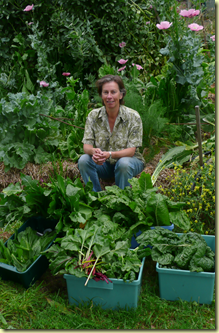
imageSilver beet rules the whole of my vegetable garden if I let it, so I take what I need for myself, one meal at a time, and feed the rest to the chooks. There is always some that gets away and goes to seed, flopping all over its neighbours. So, I grab what I can and tie it up to a stake. Then it is out of the way and I can go on gardening around that 1 plant. Problem solved, stress released, move on.

In the photo above, my garden became overgrown with 2 massive, self-sown pumpkin vines and, at the time, I could not store them all so I swapped 98kgs of random pumpkins for other produce at a local organic grocer. (7 years later I still love this shirt!).

In this photo, I am taking my over abundance of greens to the same shop to swap for other things. (7 years later, that is still my favourite gardening shirt!!).

I have a wonderful, weeping Lady in the Snow apple tree with the most delicious apples you can imagine. Now it is laden and many are falling. I keep looking at it from the back door and remembering the year I did not waste a single apple. My chooks roam under that tree (keeping it free of coddlin moth) so they peck at them on and off but there are too many even for 5 chooks. Today it is raining (so I won’t be gardening) and I will collect a basketful and juice them for the freezer (my freezer loves apple juice Smile). I will take some to the friends at the community garden. I will pick one every day when I am gardening and stand there and enjoy it. I hope to wrap lots in paper and save them for later. The native honey eater birds love them too. Still there will be many dozens “wasted” but they will all go back into the soil and feed the tree for next year. That is the cycle of life and how it should be. You could rake them up and put them in the compost if you like. Problem solved, stress released, move on.

Think cycles. Then there is no such thing as wasted food from the garden (or wasted anything, really). The consumer is encouraged to think in lines: buy new, use, discard waste then buy again, etc. Nature revolves in cycles such as seasons and the recycling of living matter. By buying something from a friend or secondhand shop (or tip-shop or gum tree if you are in Australia) you are moving to stage 2, where you are re-using something perfectly good that someone else has thrown out because they are still thinking in lines and they want the latest model or fashion.

After my secondhand microwave stops working, I will use it as a seed storage cupboard out on my porch (with the parsley I wrote about on facebook today!). Then I will find another second hand one in perfect working order and, because it will only cost about $20, I won’t be stressed about it when it stops working after a few years, or if it is the best one! This is permaculture principles 10 (use and value diversity) and 12 (creatively use and respond to change). See below.

Permaculture principles in this post:

Design Principle 3: Obtain a yield3. obtain a yield


Principle 5: Use and value renewable resources and services5. use and value renewable resources and services


Principle 6: Produce no waste6. Produce no waste


Principle 10: Use and value diversity

10. Use and value diversity


Principle 12: Creatively use and respond to change

12.Creatively use and respond to change


Permaculture ethics in this post:

Earth care, people care, fair share