Kitchen Garden Guides

Showing posts with label Thoughts. Show all posts

Friday, May 18, 2018

Rekindling the spirit within

It is only weeks until I hand over my little wholefoods business to new blood. Tiny though it is, its creation and success has been in no small part due to my intensive commitment to sourcing organic, Australian ingredients from individual farmers and makers as well as the individual needs of my customers. The time involved in doing so has meant my head has had little room for the finer workings of my food garden and its seasonal systems.

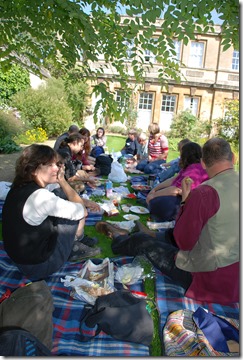
Last night I began reading some of the food gardening blogs in the side bar here and it has sparked a firecracker reaction in my heart and head to sow and plant all manner of interesting edible plants again. Maybe it will happen that I reconnect with old food gardening bloggers as well as find new ones, from far corners of our planet. Facebook has not taken them all away and turned them into clickers and likers; they are still there, writing and sharing their experiences to any who choose to come by. Below are the food gardening bloggers who gathered at the Oxford Botanic Gardens in 2008. None of us had ever met before but we had all read each others blogs.

DSC_0014  Bloggers gathering at Oxford Botanic Gardens, 2008

As winter creeps in and my head loosens its ties to being a wholefoods sole-trader the spaces will be filled with the inner warmth that comes with sorting and sourcing seeds, reading and writing about food gardening and planning for more nooks in my garden, to grow unusual vegetables. I look forward to working in the cold, misty, winter garden, rugged up and conscious of the life there; in the soil, in the trees, in the pond and in the sky.

My house is full of books about growing and cooking. During these past 8 years I have not stopped buying and reading them. Now the future will be about the doing and the eating and the sharing and the pure joy of it all.

Life is good and I am almost there…..

Sunday, February 19, 2017

How to make soil and compost with no work

When it comes down to it, I am either lazy or clever….. probably lazy! As well as that, unlike many people, I don’t like buying things much, especially if they are in plastic bags and come from far away or if I have to get in my car to go and get them. I like staying at home and using what is around me which means I also like to sit on my verandah with a coffee and think about how not to have to go out, but still have things I need!

image

I like sowing seeds I have saved and I often need to have plants in pots for a while until there is room in the garden and I like compost; I just LOVE the feel and smell of beautiful compost. All this means I need something to put into my seed trays, something to put in my pots and something to dig into the garden….. and here is how it gets done at my place.

My chooks live in a kind of man made forest….. well, some of it is man made intentionally, some of it is a consequence of people living here. Some years ago someone planted two oak trees and a few fruit trees, all very much too close to one another, if you ask me, but they were there so I left them there when I moved here. Someone crazily planted 2 buddleias, which are now massive, one of which the chooks have chosen to roost in at night, instead of in the funny little tin and apple crate structure which they now lay eggs in, mostly. Then, unintentionally some mallow “tree” seeds probably blew in and a few wild plum trees grew on the neighbour’s side of the fence and some other weeds and plants got a hold and now it is quite a lovely forest for chooks. Add to this a lazy woman who throws most of the weeds from the vegetable garden and elsewhere, into the chook yard for them to deal with.

image

Next, the oak trees lose their leaves in winter and half the chook yard becomes literally 30cms or more deep in oak leaves. I keep tossing weeds on top, the mallow sheds its leaves too as do the  fruit trees, the other plants come and go and for months and months the chooks turn it all over, pecking at insects and edible bits and pieces, which they turn into eggs for me. Sometimes I can hardly open the gate because the chooks ALWAYS kick and scratch everything towards the gate! Oh lalalala, maybe the gate faces Mecca or something but I tell you what they NEVER kick it away from the gate!

image

So, one day when I was again in there with my spade trying to reclaim my desire to easily enter the chook yard through said gate I noticed how fabulous was this mound, how good it smelt and, kneeling down, how beautiful it felt running through my fingers…. I had discovered gold; a free, easy, continuous supply of beautiful, rich soil, hand made by a flock of assorted chooks of all ages who had been throwing it towards me for years and for which I had cursed them up until this moment.

image
All set to sift some gold for seed sowing
image
Now I have raked the area and the chooks are back to see what I have revealed for them!
image
4 buckets filled. The back right is sifted.
image
Here are the buckets, now by my potting bench which is next to the chook yard. All very convenient.

Now I can easily gather up a wheelbarrow of soil, which I sift well if I am going to sow seeds into it. If I want it as compost for the garden, I dig it in, acorns, little sticks and all (but I do curse those innocent acorns when they turn into oak trees faster than a speeding bullet!). If I want potting mix, I take the middle ground (like Goldilocks) and use the stuff that is not too fine and not too coarse and sometimes I mix it with some cheap potting mix from some of those wretched plastic bags I hate!

It does take some management because you have to get at it before the next lot of leaves fall and not just after you have dumped a load of the world’s worst weeds on top! Sure, a few grass seeds etc germinate but chooks have very beady eyes and do not let many seeds go uneaten!

All in all it is a brilliant system and allows me more time to sit on my verandah and contemplate other ways to avoid going out and buying stuff.

Friday, June 3, 2016

The Chicken Feed Dilemma

I have been recently thinking about animal feed; for chooks in particular but all farm animals, in the bigger picture. Let’s think about my situation where I have 6 chooks, for eggs. Every morning I give them 2 cups of mixed grain, Australian grown, then in the afternoon I give them more grain, this time organic, Australian feed wheat (ie complete with some chaff and unwinnowed). This make about 3 cups of grain / day and keeps me in eggs all year round, plus I have plenty to give away to son Hugh and even a friend or two, at times.

Using our agricultural land to grow food for animals is worth thinking about carefully, when there are people without enough food, land cleared means native habitat destroyed and then there are the fertilisers, machinery and fossil fuels used to grow, harvest, package and transport it all.

I am feeding grain to 6 chooks and getting eggs, so I think that is a good use for 3 cups of grain / day. However, what about when my chooks get older and are no longer laying? Is it right, on all levels, to keep feeding them? Multiply that by the number of people who have chooks just in Tasmania and we can see that tonnes of grain would be going to old chooks (never mind to old horses and donkeys and alpacas and goats and so on).

Most people stop at the edge of thinking and say “Oh I don’t kill anything and my chooks can live for as long as they like (and therefore I am humane and a nice person).” However, just think about this in relation to native animal and plant survival, CO2 production, fossil fuel usage and a myriad of other, deeper concerns.

Is it ok for you to be “kind” but at the same time be killing wildlife somewhere else, where your chook grain comes from? Is it ok to be “humane” but at the same time be adding to climate change, peak oil, mining and transport problems?

I don’t think we can continue to stop thinking at our property boundary. I think that is precisely how we got into this climate change and earth destruction dilemma in the first place; putting our personal desires before the good of the whole. It may sound harsh to some, but it is far more humane, nice and kind to put old chooks into the stock pot or even into the compost heap.

Friday, August 7, 2015

Getting on with “things”

I must get up and get on with things….I must light the fire / have breakfast / wash the dishes / feed the chooks then get on with things….. I must leave this phone call and get on with things …..That’s enough time spent having lunch, it is time to get on with things…..

I have caught myself saying these kinds of things recently but why is it that what I am already doing is not considered one of the “things”? Life is no longer a thing in its own right; you have to be doing more that just living these days. This attitude always surprised me when I was a young mother staying at home with my children, spending 24 hours a day living, but not doing paid work. So many people asked me what I did all day, questioning if I was bored, insinuating at times that I was lazy or not pulling my weight in society. I knew there was not a job in the world more worth while than raising your children.

It is the same now. I yearn for days of solitude to simply get out into the garden and potter about, or cook slowly in my kitchen, while everyone else seems to be going to things, participating in organised things, eating out and travelling far and wide to see other people doing things. Gardening and cooking are seen as chores which must be done quickly or by someone else so everyone can get on with “things” most of which I have no desire to do.

5-DSC_0011Lighting the fire is a thing I love. Why do we nowadays have to turn it into a chore and hurry on so we get on with real “things”? I love greeting the chooks in the morning, with a bowl of leftover dinner and some grains for them. I stand and watch them chat about it; arguing over one piece of bacon rind when there are 6 more there if they just look and one after another having their fill and moving off to have a drink of water. Why is that not a “thing” worth getting on with?

I do get a bit cranky about this at times when I try to cut the crap from banal conversations about art exhibitions I have not been to, movies I have not seen, music I know nothing about and celebrities I have never heard of. I try to move the conversation beyond the human, to frost on the broccoli in the early morning light, frozen bird baths, the movement of layers of clouds across the sky recently, ideas and philosophies  I have read about but we are from different planets; the others and me.

Mostly I do not listen to music; I prefer the sounds of the natural world around me to the sounds of humans. That makes me a freak who does not appreciate the finer “things” of life, evidently. What is finer than the sounds of the crackling of the fire, the chooks wanting breakfast, the creek gushing along after rain, birds in the garden or a breeze in the trees?

3-DSC_0015


4-DSC_0030


Mostly I don’t care for art, except when it is useful. I’d rather have a bird’s nest on my mantel piece than a famous sculpture. I love baskets and fences woven from plants in people’s gardens,  I love ceramic fermenting crocks made from local clay, I love quirky, interesting furniture made from local timbers by clever artisans….. but I cannot be bothered with art for its own sake. These days you cannot go around saying you are not interested in art or music…. but when people ask me, I tell them.

2-DSC_0004

Recently a woman who has the most amazing singing voice and makes a living singing asked me what music I like. I tried to say “I love it when you sing at the market but between markets I rarely listen to music” but somehow it came out sounding like I was criticising music, because I don’t know about genres and musicians’ names.

1-DSC_0004

It is not enough to know about vegetables; evidently that is not a “thing” these days. I was excited because I had been to a restaurant with son Hugh where I had chosen a meal with 3 vegetables I was not familiar with (skirret, salsify and Portuguese cabbage). People laugh at this as if I don’t mean it, but I was as excited about this as another would be about a new piece of music they had discovered….. and no-one would laugh at that!

So, now I am sitting in bed writing this…. I doubt that blogs are “things” and that I really should get up and get on with things….

1-IMG_1472

Friday, May 8, 2015

What has happened to our expectations to grow food?

Every day at the moment governments are making announcements about budgets, taxes, welfare, childcare, big and small business incentives, superannuation, mental health, hospital spending etc etc but never, ever do they broach the subject of self-sufficiency or self-reliance as goals for Australians. It is politically incorrect to expect people to get out and grow their food, join a community garden and become skilled in relying on themselves. However, the simple act of doing this would, to a large extent, overcome many of our national woes.

I enjoy learning about the ancient and more recent history of civilisations and their foods. Up until almost the 21st century, almost every person on earth either grew some food or had relatives that did. Stop and think about that for a moment….. your parents and / or grandparents no doubt fitted this statement and had vegetable gardens and fruit trees in the back yard. In only one or 2 generations people have started to rely on others, unknown and as far away as the other side of the world, to provide nourishment for their families. At the same time, there has been a huge increase in obesity, depression, stress-related, chemical-residue related  and diet-related illnesses.

Interestingly, growing food has become a middle-class activity, seen as something you do in your spare time, after you have bought all the accoutrements that modern-day food gardeners seem to “need” such as raised garden beds and soil (as though the soil in the ground is not good enough these days!).

I am reading a wonderful book, given to me by my fabulous neighbour, Jilly, who recently blew in, in full wet weather gear, in the midst of the coldest and wettest day this year. We sat by the fire and talked for 2 hours, sharing interesting snippets about books, gardening and life. We seem to get together only about once a year but Jilly’s amazing knowledge of plants, history and everything in between keep me inspired until our next coffee. I now look at the old lino pattern on my kitchen floor as steeped in history, instead of annoying!

The book is called “The Nature of Gardens” and is a collection of essays brought together by Peter Timms. It sounds dry and just another intellectual, middle class look at garden design etc but I assure you it is not. I recommend it to anyone who has read this far through this blog piece!!

image

The first essay and my mother’s stories of life during The Depression have brought me to my laptop to write about the recent past’s expectation that you grew as much as you could and the poorer you were, the more you grew. If your job was not well paid or not permanent, you at least knew your family was going to eat well. This essay points out the interesting fact that when workers in the mines and in the coal and steel industries went on strike in Newcastle, NSW it was prolonged affair and they would not relent. This was possible because these same men all had food gardens so, even with no income, their families ate well. In fact, the free time afforded them because of the strikes meant that jobs in the garden and around the house could be done, and vegetable gardens better tended than usual. This is called resilience and is sorely lacking today.

image

If I had one day to rule this country, I would insist that welfare would include assistance for you to learn to grow food and even an insistence that you join a community garden where you would gain not just hands-on know how but broaden your social circle and gain a sense of community and self resilience. I know from experience how beneficial food gardening with others is to every single person who joins a community garden. But I also know that insisting people do something is not the best way to get them to do it! People who are transient and those who have short or long term rental are given a place to base themselves by belonging to a community garden. Once you get into a community garden then, even if you move, you take with you the confidence to find another, wherever you go. It is like having an extended family; always there and ready to nourish your body and soul.

image

At the Cygnet Community Garden we donate fresh vegetables weekly to the Uniting Care Food Aid in the same street as the community garden but I want to offer to walk with the recipients, one at a time, to the community garden and invite them, quietly and without preaching to them, to come along. This is my new goal….. if you have any helpful ideas of how to make this small gesture work please feel free to share them with me.

image

Friday, January 16, 2015

The shack dimension

I think any minute I will see a goanna walk, in that prehistoric gait they have, past my window as I sit and absorb nearly 5 years’ worth of peace. The sand hill which nestles the shack is dry, sporting tufts of grey shrubbery, a few escaped succulents and lots of sand. This morning I cleared the sparse, prickly, dead weeds from the front where I like to sit and watch the sea. I came across a hole large enough not to be a snake hole; fresh, white sand having been cleared from its entrance quite recently. I am looking forward to seeing the occupant as, over the years, several individual, prehistoric creatures have wandered slowly past this window making me feel even more that the shack is in a different dimension than the rest of the world.

The longer you have been away from the shack, the stronger is its effect. You can leave home with your head full but arrival at the shack empties it. The first morning here begins your transformation to a new dimension where your whole, “real” life no longer exists and is replaced with space, which refuses to be filled. Time almost stands still; days become long and languid, ruled by nothing and filled simply with the light and sounds of the sea.

Any others you may encounter have been similarly transformed. Children and dogs frolic with cricket balls, sand castles, little boats and beach towels. Parents cease to fret and, instead, enjoy fun, laughter and relaxation. Even testy teenagers are happy!

At the kiosk, the only shop for 20 kms, the shop keepers smile and chat, fill lolly bags, talk about fishing and are happy to see you back for the holidays. Outside, the wall is lined with kids’ bikes and at the door sit dogs, waiting patiently. Here, children ride their bikes in groups of mixed ages and there is not a smart phone or head phone to be seen anywhere. Fashion is not in this dimension either; everyone has bare feet or thongs, an old hat and a t-shirt over bathers.

In the last 5 years, since I have been in Tasmania, McMansions have sprung up here but those people are either inside with their technology, out fishing in their McMassive boats(as evidenced by the increase in Four wheel drives and empty trailers lining the streets near the boat ramp)  or have similarly been transformed into the shack dimension and blend with the rest of us.

Day one of waking in the shack dimension often ends without even walking the few steps to the beach. After so much yearning for a swim in warm water, a paddle on my board and a long walk on the beach, unbounded by coves or cliffs, it may seem odd but such is the transition. I don’t have to do anything and for a couple of days I don’t. I sit and watch, I read, I sleep, I look out for the goanna and I feel wonderful.

Life is good. I am there and taking it slow.

Thursday, July 11, 2013

One creature to another….

I don’t believe in gods. I don’t believe in life having meaning. I don’t understand why people need meaning. Isn’t it enough to be a human, in a world full of beauty, filled with plants and animals, amazing geological structures and incredible events like sunsets and rainbows?

I feel incredibly lucky to be alive. Doesn’t every body? I feel free to be entirely who I want and I take full responsibility for how I am. I rarely even think about this but I have been watching Richard Hawkins’ programme called Sex, Death and the Meaning of Life in which he explores various ways people seek meaning.

It seems to me that a lot of people are bogged down trying to find a meaning or a purpose, when there is none. Humans are not special and they do not have meaning any more than an ant or a cabbage. To me that is entirely liberating. When I am totally responsible for my life it empowers me to take charge of it because if I don’t then my life is a waste of time, time spent waiting for someone or some god or some fate to guide me.

I really think that humans have become entirely self-centred; rarely thinking of the wondrousness of life at all; rarely taking time to watch the light falling on a frosty leaf or listen to the croak of a frog on a pot plant and certainly almost never feeling connected to these things, one creature to another, as I do.

So obsessed are people with meaning and believing in things that if you are not like them, then you are not often allowed to say so…. although I do make a point of saying so, at times. I said so recently, to a dear, Christian friend of mine. I think she felt sorry for me; me not knowing God as she does. We talked about the soul. She said I had a good soul. Evidently God gives us our soul. Well, I said I made my own; I am the accumulation of 54 years of being who I choose to be with life’s ups and downs moulding me along the way.

We were sitting by the window at the shack. Being there, right by the sea, for a great part of my life; seeing and smelling and feeling all that such an opportunity has given me, has definitely influenced my love of and connection to everything around me. That is where my soul comes from, not from a god.

Get rid of the gods and we would get rid of most of the fighting in the world. How can you fight with someone when you are standing under a beautiful tree or cooling your feet as you walk in the sea or watching an insect crawl on your hand or smelling the delicious aroma of a mango?

Friday, February 15, 2013

Worldwide radio and tv

I am now paying less for my internet than ever before and getting more. Consequently I am able to spread my wings and listen more often to wonderful, interesting, funny and educational radio from around the world, while I do indoor jobs. I’d be interested to hear of online radio stations that others could recommend.

I used to love Radio Aquitaine but I don’t think it is still running. It was a great station in English and French, depending on the topics and broadcasters; started by an Australian woman too!

BBC radio has some wonderful programmes and podcasts. I have just finished listening to one about food trends around the world. Not as dull as the title might sound, its worth getting your teeth into!

BBC Food programme: Provenance and pleasure, history and health - Radio 4's weekly look at food. Making sense of food, from the kitchen and canteen, to the farm and factory. We place food in its historical and cultural context; call to account policy makers and industry decision makers; and celebrate the sheer pleasure of good food.

I am soooooo tired of Tasmanian radio and the endless, narrow range of topics covered; from forestry to football and back again.

And when it comes to TV, I now love to stream from anywhere I can. I am delving into the Youtube station called BBC Worldwide. To overcome the problem of those outside the UK not being able to watch the enormous number of fabulous BBC broadcasts, they do it through Youtube. Brilliant! A long programme will be cut into parts but its no problem to watch it this way.

Now that I have an HDMI cable from my laptop to my new TV, literally the whole world is in my hands. It is a wonderful way to not just hear about what is happening overseas, in whatever field interests you, but to actually watch it or listen to it direct from that country, in their own words…. and that includes watching Gavin’s Monthly Podcasts, from The Greening of Gavin, in Victoria.

I want to find other stations but have not had time yet. Do tell me if you know of anything worth seeking out. Next I want to get a radio that can play via wifi so I can listen while I am in the garden too. I know they are available now but I need a battery operated one that will work quite some distance from my router.

Technology can be amazingly wonderful….. funny that I listen to digital, international radio while I sort my seeds, preserve lemons, run my little wholefoods business and generally live a very green life!

Friday, June 15, 2012

From darkness….. light


garden of hope

From Roger Doiron at Kitchen Gardeners International….. gardeners helping gardeners

For gardeners in wealthy countries, it's easy to take for granted the psychological benefits that a garden can offer.  In springing from the ground, gardens offer a living metaphor for rebirth and a fresh start.  It was for this reason that KGI was so happy to be able to fund the Garden of Hope project in Goa, India.  Rather than tell this uplifting story in words, we'll leave it to the presentation to tell it in pictures.

Please watch the slide presentation, share it and help Sow it Forward….. it might just change your day….. and it could change someone else’s life.

Thursday, May 24, 2012

Late Autumn in my Kitchen

The days are really short now and I so enjoy early evenings in the kitchen, surrounded by the day’s harvest, either from my own garden, the community garden, the weekly Cygnet Organic Market, the new organic grocer in the main street or from friends who have dropped in during the day.
The beauty of freshly harvested vegetables is astonishing and invigorating. Many people adore the tomato season but for me, late autumn brings such a variety of colours and tastes that I can hardly decide what to eat.
image There is the deep, rich, intricately patterned red cabbage, which, if teamed with slices of apple and slowly stewed, becomes a sensational vegetable accompaniment, even without any other ingredients.
There are freshly dug potatoes, none better in the world than those grown in Tasmania, where the perfect weather and soil produce unbeatable potatoes, in almost every back yard. I have 10kgs of kennebecs from a neighbour; fluffy white inside and with a skin that bakes crisp and full-flavoured. Many people here prefer pink eyes and Dutch creams. I squeeze open a good sized, baked kennebec and top with lashings of home made yoghurt mixed with crushed garlic and a handful each of mint and chopped spring onions. This time I sprinkled on some of my dukkah too.
As winter weather begins to set in someone comes by and gives me something I have been searching for – red capsicums with thick, meaty flesh and a flavour I have not had since leaving Adelaide 2 years ago. Why was I the lucky recipient? I shared some seeds, about a year ago, in the hope that someone would have success and all I asked in return was one red capsicum. Well, I was given 5 and treasured every mouthful; some fresh and eaten like an apple, others cooked, with no other adornments! Needless to say, the seeds sit on my mantle piece drying out….. I am determined to grow these small, pimento-style capsicums successfully myself next season.
Winter salad greens are a joy to behold and mine include the very dainty frilly mustard, self-sown miners’ lettuce, various little chicories (speckled/ broad leafed/ tall and red), French sorrel, chervil, mint, lettuces, bulls blood beetroot leaves, wild rocket, bok choy, mizuna, nasturtiums, red dock etc etc. I love salads in winter, they beautifully complement and lighten a hot meat stew or a toasted cheese sandwich. But its dark now and I didn’t take any photos!
image I came home today to find several bean pods by my back door, in a paper bag. They revealed some magnificent jewels, on opening. If ever there was a magnificent collection of vegetables, it would have to be the bean family.
image


Sadly, most people discard any fat bean pods left on their vines at the end of the season and they are missing out on a display like no other! The names of beans are quite confusing, sometimes named after the colour of the flowers, sometimes after the pods and sometimes after the mature bean seeds found inside those dry old pods you forgot to pick. Interestingly, today, the purple podded bean revealed ordinary white bean seeds while the others, which all had plain, green pods, revealed 3 very different seed colours and sizes, inside. Never count your beans before they hatch!
imageLastly in my kitchen this week are some mini muffins made with apples (from the Cygnet community garden) and orange blossom honey, my favourite honey, from a bee keeper whose bees pollinate the orange groves in South Australia. The native trees that form the basis of honey in Tasmania did not flower well this year, except for the Leatherwood, and I decided to fill the gap with this light, sweet, fragrant and lingering honey that makes me smile with delight. I have added it to the burgeoning list of South Australian things I sell at the Cygnet Market and in my little Garden Shed and Pantry business.
As the cows outside my kitchen window chew their cuds, as interested in me as I am in them and the geese merrily mow my clover paths even in the pouring rain; when the frogs croak from every corner of my garden and the chooks start laying well again; when the nights close in early and morning mists linger across the hills, I feel grateful to be alive and glad I am here at the bottom of the world, in paradise.
Wednesday, April 18, 2012

Simple Lives.....com.au

Interesting, isn't it, how we have so easily assimilated technology into even the simplest of lives. And so it was that Sophie and Greg arrived at my door, on their bicycles, one evening recently, having contacted me via the world of bloggers. A delightful pair they are, riding around parts of Australia and then the world, gathering notes on living simply, for a future book. Visit them at simplelives.com.au

image Cygnet is a magnet for just the people they needed to speak to so I had arranged for a get together over dinner at my place, that evening.

We ate from the garden, talked from the heart, told our stories and aired our thoughts about the why, how and who of trying to live simpler lives.


Greg took copious notes and asked everyone as many questions as he could think of, ending up with enough information already to write a book!

So, what are simple lives? The answer is actually very simple too; living a simple life requires you to be connected to a community so that you can share tools, seeds, "stuff" and food. It means re-humanising yourself. It means caring.... about your neighbours, your friends, your environment and your impact on all of these. It is not about being a hermit, surviving alone.

How does one begin? Most people start slowly and unintentionally..... growing a few vegetables, reading labels in the supermarket, catching a bus to work or joining a community garden, buying a magazine on sustainable home improvements or organic gardening etc etc. Very slowly the meaning of life questions you thought were going to be answered by frantically driving your children to their next activity, working late to get more money and buying new furniture or gadgets, still rear their heads and remain unanswered.

One evening, about 6 years ago, I went to a talk. I have now forgotten the topic because what happened was that, in the interval, I met people. Some of these people made me think very differently; opened my eyes to the bloody obvious..... and that was that there is a whole lot of people out there, in my city of Adelaide, who thought just like me. I realised I was no longer a hermit, growing my vegetables, NOT enrolling my children in structured activities, refusing to use chemicals in my home etc etc; I had found community.

Simple lives are just that.... plural. The hardest part of the journey is finding them. The internet is a good place to start. Make a blog. Read blogs listed in other people's side bars. Leave comments. Get connected to the online community and you will find that your neighbour may well be there too!

image

image


Good luck Sophie and Greg. Have fun. Take in the vibes.

image


Life is good; get there fast and then take it slow.

Wednesday, April 4, 2012

Red and Green

image Green is the changing colour of tomatoes; in particular those on a bush which came up by itself in my garden in January. I did not give it much hope of delivering a crop of ripe tomatoes, since there could be frost in March. However, to my astonishment, it has the biggest tomatoes of all and the most. I have never seen so many perfect, large tomatoes all at once on a plant. Moreover, it has produced the most ripe tomatoes this season, of all my tomato plants and I am picking several ripe ones daily from this plant. In this photo alone, there are more than 15 and with the warm weather this week, they will ripen quickly. Unlike other plants that are starting to reduce in vigour, this one is powering on, full of vitality. Needless to say, I have saved many of its seeds. I wonder how well they will produce next year.

image


  It is interesting the way certain colours appear in certain seasons. April in my garden is the red season.... from the red chard going to seed, to the out-of-season sweet peas, autumnal Virginia Creeper, red onions, Lady in the Snow apples to late scarlet runner bean flowers, strawberries, Bulls' Blood beetroot leaves, dahlias, bottlebrushes, nasturtiums and things called red, like red cabbages and Red Russian kale....

....and finally, 3 red capsicums. Hooray! But in my excitement, I ate 2 and forgot to photograph the third and now its dark!! I will write a note right now and do it tomorrow.

Wherever you are, enjoy the beauty in your food gardens.

Tuesday, March 20, 2012

Seed sharing event in Amsterdam

Thanks to Patrick, at Bifurcated Carrots, for sharing this little video of a wonderful day of seed sharing. Wouldn't it be exciting to have one of these in Tasmania (and in every state of Australia)! I might make it my goal for the next 2 years to make this happen.

Tasmanian families have some of the longest Australian heritage in our country; having stayed put since their ancestors arrived as convicts, sailors or farmers in the late 1700's. In fact, I found a coin in my garden.... dated 1792!! There must be a treasure trove of seeds here, but as in so many rural places, generations of growing food and saving seeds is just an ordinary part of life to them..... but to me it is exciting and liberating and what makes me get up in the morning!

Friday, February 17, 2012

Soil and people, for life

Thanks to my good friend Deb for sending me this link!

People with nothing are often the ones to inspire us, as you will see at Soil For Life.

logo

Read more stories like the one below, from Cape Town, South Africa at Soil For Life.

Did you watch The People's Supermarket?

They take the food co-op idea even further by firstly, utilising the man-power of the members to pick local fruit and vegetables rejected by the big supermarkets, for reasons such as the cucumbers are not straight enough or the tomatoes are not big enough. Many farmers struggle to make ends meet because of the uniformity that supermarkets demand of the produce; a uniformity that says nothing of taste, nothing of fairness to the farmers and nothing of the growing methods used.

Secondly, to minimise wastage, they create prepared dishes from food coming up to its sell-by date. This has proven to be such a big seller that they cannot keep up with demand.

Thirdly,the system provides inspirational training and life skill opportunities to the local community and many have managed to gain qualifications and get paid jobs simply by participating in the scheme.

Great news! Pass it on... Join in.... Be part of the solution not part of the problem.

Wednesday, February 15, 2012

Apples....

Its all very well, this whole "simple life" thing but it takes a hell of a lot of time, every single day, and is seriously getting in the way of blogging.... I have sentences being produced in my head all the time, for a blog piece I want to write, but that topic, and subsequent topics, are requiring all my energy and time, leaving little space in my day for writing.

image Like now.... apples..... the first of the season are just arriving at the markets and I was so excited to find Gravensteins at the Cygnet Market last week. They don't keep well... so now I want to make apple pie but I really have to write what's on my mind... You see, Gravenstein is a crisp, juicy, delicious eating and cooking apple which I had never seen in Adelaide. Which brings me to a very important point - Tasmania used to be nick-named the Apple Isle. It has the perfect climate for apples and hundreds of varieties were grown here for all Australians and even shipped around the world, in the northern hemisphere's off season. It really was the basis of the economy for Tasmania for a century or more. The important word is "was".....

However, for some ridiculous reason, cheap, inferior apples are now being imported from China and New Zealand, to fill the shelves of the big supermarkets on the mainland and overseas!!! Tasmanian farmers are therefore ripping out orchards of heritage apple trees in order to find something else to grow that the world of supermarkets will buy. It is criminal that Tasmania is being treated this way. It makes my blood boil as I have never tasted better apples and never seen such variety as the apples at the markets and in the gardens here.

This has far-reaching consequences for Tasmania. One of those closest to home is the recent closure of the Cygnet Fruit Processing Company just down the road from me. I used to see the steam coming from the chimneys as I sat in my kitchen and ate my breakfast last winter, grateful that I did not have to be at work on those frosty mornings. imageBut now no more steam.... No more work there for the locals and no tins of delicious, out-of-season apples and other fruits for the customers to buy.... No more cardboard boxes proudly stamped with Cygnet Apples ink..... and long gone is the Cygnet Apple Festival, along with the Apple Queen parade down the main street.

All that is left is the story.

Sigh....

Wednesday, January 25, 2012

Agriculture or electricity, for Tasmania?

This discussion (below) is copied from a newsletter a friend of mine writes, called Crikey dot Ken. Ken is always on the ball about issues Tasmanian and especially those relating to the D'Entrecasteaux Channel.

I don't know enough about Tasmanian soil to make a good judgement but I do know that the area being discussed for this irrigation scheme is prone to drought, and that is why it is cheap land, while many parts of Tasmania have excellent rainfall.

I should explain that Tasmania has well established hydro-electric schemes and some new wind farms. It is in an ideal position to make all its own electricity if it manages these well and invests in innovative mini-hydro farms like this one. Its only other option is to pump electricity across Bass Strait from the mainland, at huge cost, which it has started doing, much to the annoyance of customers like me who are seeing their costs double!!

One wonders what is really behind all this; one thing is for sure - it is about money and politics, and not about what is good for the future.

An agricultural bonanza for Tasmania or just a few others?

There is something not quite right with the scheme to bring water for irrigation to the midlands of Tasmania from Arthurs Lake. A motherhood question would be, ‘Are you in favour of an irrigation scheme that would see productive farms producing food that would feed many thousands if not millions of people in Australia and across the world’? This political proposal is to pipe / drain water from Arthurs Lake in the Central Highlands to the lower cost land illustrated in the map to the right. It’s an engineer’s dream job.

image But what are the cons apart from the pros? Arthurs Lake is a good size lake that sits below the much bigger Great Lake of Tasmania. The pros of Arthurs Lake is it has a catchment while the higher, bigger Great Lake has virtually no catchment apart from direct rain and snow. The Great Lake, last ten or twenty years, has been at the best say variable. The level of the Great Lake over the last twenty or more years has been bordering on empty most of that time. Traditionally the method has been to pump the Arthurs Lake water up to the Great Lake in the off peak and then funnel it down via Poatina Power Station which has been believed to produce the most efficient power generated in Tasmania such is the fall of the water. It has six turbines, with a combined generating capacity of 300 MW of electricity. There is a net gain to Tasmania using Arthurs water.

So who are the winners and the losers?

Now we are told Hydro Tasmania are being asked / told to for-go that water from the Arthurs Lake to feed the new Tasmanian Midlands Irrigation Scheme. If there has been modelling as to how much water is required for Irrigation; what is that amount? Does it equate to the water forgone by Hydro Tasmania for electricity generation? If the irrigation authority get it wrong with their estimates being on the low side of irrigation water required, will it be just as easy, or even easier, to take water out of the Great Lake too via Arthurs by reversing the past usual process?

As the Great Lake is likely to experience even lower precipitation and snow in the future will that mean that the most efficient power producer in Tasmania, Poatina, will be idle more times than not for lack of water that is drifting down a pipe line to the midlands to produce food and wool in a much less efficient way than Hydro Tasmania creating good clean electricity that is destined to fetch astronomical prices on future mainland markets. The infrastructure is already there to produce electricity.

The irrigation scheme will cost 100 million dollars for a harder to earn, unknown return This is more a shift of money from the electricity uses of Tasmania to the pockets of a few wealthy investors and some hard working farmers. In hindsight, all will be left is a few trout fishers looking at the mud of Arthurs and the Great Lake much like the older anglers reminisce about the great days of the Shannon Rise. This could be one of the greatest shift of capital from the Tassie battlers to the corporate board room, ever, and that’s saying something.

Thanks Ken for allowing me to put this on my blog.

Monday, December 12, 2011

Foraging for Food Walk

All night it poured with rain. All through breakfast it continued. I was sure there would be cancellations. I checked my emails and listened for the phone.... then they started to arrive; early, happy, laden with home-made food and drinks to share. Before long the clouds lifted and as we stood in my lawn, while Jilli gave us her introduction to the world of weeds and herbs through human history, I thought to myself how wonderful it is here.... how lovely the people are..... how they turn up prepared for any weather...how generous they are..... how lucky I am to have Jilli as a neighbour.

image We set off to Jilli's and spent a good hour and a half delighting in her amazing knowledge of English edibles which now run rampant in our gardens. Jilli's garden follows the same creek as flows through my garden and on the banks of it she has naturalized what we generally call weeds but are, in fact, the staple foods of the peasants of England for thousands of years. Here we all are, walking beside the trickling stream and looking for the little orange markers Jilli had used to mark the plants we were learning about.....

Telling the difference between Dandelion and....
image
Cat's Ear, for example....
image
Jilli's newest composting method is this  woven design from Suweto.
image
Then back at my place for a shared lunch....
image

image Jilli had made stinging nettle soup, using the large, English nettles from her garden but I have the smaller, Tasmanian nettles in mine. The soup went so fast that this is all that was left on the hotplate of the gas BBQ for a photo!image

I made a dip which started out being chickweed pesto but, oh lalala, I had an embarrassing number of disasters while making it and thought it was ruined..... but people loved it and even asked for the recipe!

image Amanda is a blogger who came all the way from Hobart and brought this fabulous elderflower cordial (quite different to Deb's divine nectar but equally as delicious), amongst other things. She has a great blog called Gourmet Gatherer. Since she is new to blogging, do call in on her and say hello. I was lucky to get this photo of Fern and John with the cordial because it too disappeared in no time!

image We finished the afternoon with coffee and Judy's soft and perfect scones.

Jilli provided us with handouts for the weeds we happily now call friends, and even recipes to make sure we enjoy them in our everyday lives as well as a comprehensive reading list.


This kind of knowledge is invaluable for we Australians who have no tradition of eating from our own wild places, having scoffed for too long, over the last 2 centuries, at the Aboriginal people who knew the land and Australia's own wild edibles. We must now learn to eat weeds from other countries, gathered in our own gardens, and to find what knowledge we can about edible Tasmanian plants.... including a native elderberry and a raspberry found in the forests.