Kitchen Garden Guides

Friday, June 4, 2021

June 2019 Kitchen Garden Guide


At last winter has arrived! Rain, hail, snow and cold winds have streamed across us but will it last? The BOM forecast is for a drier and warmer than average winter, with plenty of frost (because of clear skies). This frost bodes well for next season’s apples, pears, cherries and berries, all of which revel in plenty of cold temperatures while they are dormant. But the warmer day time temperatures may interfere with that! Frost is also excellent for developing carrot and parsnip flavour and for enhancing the amazing colours in vegetables such as rainbow chard and red chicories.

Pumpkins

One vegetable that does not like the cold is pumpkins. If frost lands on them and freezes even a tiny spot then that spot will go soft and eventually rot. So, for best storage, pick them when the stems have completely dried and browned off. This has not happened with mine this year. With all the warm autumn weather the leaves have stayed green. Nevertheless, the time has come to collect them up and bring them inside to dry and harden, upside-down, in a warm place like on the mantlepiece above the firebox. Cut stems at least 15cms long as cutting them closer to the pumpkin before they are dried off may let fungus creep into the pumpkin and it will rot from the inside. Once the stems are fully brown and crisp, you can cut them short. Store them on their side for best results.

Beetroot

Beetroot is related to spinach and red chard, but did you know it's also related to quinoa?I am growing quite a bit of beetroot this winter and, with staggered sowing way back in Jan/Feb/early March, it will keep me going for months. You can also sow it in spring as it is very carefree and loves the cold, cool and warm weather but I prefer to eat it in winter. Beetroot goes well with apples, walnuts, rocket, lentils (all autumn and winter crops), basil, balsamic vinegar, goats cheese, and gin herbals (juniper, cardamon, coriander, cinnamon, citrus and also the Tasmanian pepperberry). It also makes a wonderful probiotic drink called kvass which, like all fermented foods, is packed with enzymes and microbes for gut health and immune boosting.

I peel beetroot for kvass because it has little bumps and hairs that may house microbes that can affect the fermentation. Once peeled, chop 2 large organic beets coarsely and place in a 1.5 litre jar. Add 1 tablespoon of salt and 1 litre of water. Put the lid on and shake. Label with the day, leave on the bench for 5 days then refrigerate. Drink daily. You can refill once with water when it is all gone but then you need to start again. Delicious!

Winter greens and mulch experiment

Why are my winter greens (kale, chards, bok choy, wasabi greens, chicory, spinach, mizuna) especially strong and healthy this year? Because I added inoculated biochar, compost, blood and bone, lime and hay. Before planting I had intended to add more hay but I added a thick mulch of old sheep manure instead because I watched a video by Charles Dowding in which he mentioned using old sheep manure as a mulch in very frosty areas.

Seaweed in winter

As winter storms in the roaring 40’s send high seas crashing onto the shores of Tasmania, kelp and other sea plants are strewn on the beaches. I heard on the radio that we are allowed to collect seaweed from most beaches at the rate of 100kg / day in Tasmania. Seaweed is heavy, so that is not as much as it sounds. I have some great ideas for using it! Seaweed contains trace elements which we often neglect to think about in our food gardens (and our stomachs).

1.   Wash it and eat it; either raw (if tender enough) or cooked or just put a piece in when you make soup then discard if its too tough. I have eaten many local seaweeds, especially from south eastern Bruny Island where the water is pristine.

  1. Place tubs or large buckets here and there in your garden. Half fill them with seaweed and fill to the top with water. Cover if you like. Keep a ladle nearby. Whenever you see some plants looking a bit weak or off-colour give them a tonic of 1 part seaweed water to 9 parts water, in a watering can. Pour over the leaves.
  2. Completely cover your asparagus patch with a thick layer of seaweed during winter. Leave the rain and the worms to do the work.
  3. Seaweed is a wonderful addition to mulch under fruit trees.
  4. Add it to your compost heap.

Winter herbs for health and flavour

Do you love pesto and lament the end of fresh basil from your garden? Well I make a wonderful pesto with chervil and almonds / rocket and pistachios / parsley or nettles and walnuts.

There are so many lovely herbs that either grow and thrive only in winter or continue to hold their colour and flavour even in winter. The former includes the slightly aniseed chervil, with its pretty, soft ferny leaves which I grow as a block and clip by the handful, with scissors. Also in this category is coriander with its robust flavour and growth habit. Rocket is a favourite everywhere. Parsley is a fabulous winter herb, readily self-sows and is useful all through winter in meals and as a wonderful source of vitamin C, in our climate where oranges are rare in our gardens. The latter includes rosemary, Tas. Pepperberry leaves, bay leaves as well as fennel fronds and flowers.

Seeds to sow in June

Sow in the garden:

Broad beans

Salad and spring onions

Shallots

Chives

English spinach

Radishes

Sow in trays to plant out later:

Brassicas

Globe Artichokes

Coriander

Chervil

Lettuce

Rocket

Asian greens

Plant out

Garlic

Asparagus crowns

Divide rhubarb

Winter herbs

Winter flowering annuals

Globe artichokes

Sunchokes

Bulbs

Asian greens

Lettuce

Spinach

Fireside Reading

“The Veg Doctor’s Illustrated Field and Fork Guide to Potent Plants” by (Tasmanian) Hazel MacTavish-West


June 2020 Kitchen Garden Guide

 Many people have become corona gardeners, growing food for the very first time. If that’s you, then welcome to a whole new world of joys, tastes, weeds, disasters and, amongst it all, the glorious feeling of coming home to something deeply satisfying, something deep within the soul of all of us. My tip is to relax; observe the details of what is happening to each leaf that grows, admire closely every insect and bird that visits and follow the path of the sun and wind as they wind their way through your day. There is no rush.

Magnesium

As the sun dips low in the sky and the temperatures drop, plants are relying on their strength to remain healthy, just as we do. Problems become evident quite quickly sometimes, especially in pots. My citrus, in big, concrete pots on my sunny verandah, are laden with fruit. Their leaves have been green and fruits growing well but I can see signs of yellowing of some older leaves, which could be a sign that a dose of magnesium might help. Purple, red or brown may also appear on the leaves of other plants. We all need magnesium and if our plants are short of it then we who eat the plants will be short of it too. It is vital for photosynthesis, which obviously happens less on these short days, which is why it raises its head now.

Add about 3 tablespoons of Epsom salts to a 9 litre watering can, stir well to completely dissolve, then water the root zone. For pots, you can also mix into a spray bottle and spray the leaves. Repeat as required. It is a gentle remedy.

The name comes from its discovery, bubbling up in ponds in the English town of Epsom, in the 1600’s. Farmers noticed that wounds of cows that waded through the bitter tasting water healed quickly. Many people in England began to travel to Epsom to experience the numerous health benefits, particularly the relief from the painful symptoms of gout and for the natural purging effects of the water.

Tasmania is surrounded by sea and we are now learning to forage the shores and shallows for food. As a longer term strategy, magnesium can be added to the soil simply by adding seaweeds to your compost or liquid feed. Magnesium can be added to your diet more directly by eating the seaweed yourself. All of the longest lived peoples of the world eat many different sea plants; think Okinawa (Japan) and Sicily.

A dash of another season

It is the weather for soup and none is more satisfying and cleansing than garlic soup which I make from a recipe a woman in France gave me. Oh lalalala it was one of the best soups I’d ever had and she wrote it out for me in French, which always adds another challenge when I decide to make it! In the freezer I have some stocks made with bones from animals raised locally, ethically and without chemicals. These form the base of all my winter soups. In summer I usually use vegetable stock or bottles of my tomatoes.

As the garlic cloves which have not been planted begin to sprout, I follow a Chinese friend’s lead and stand each clove upright, side by side in rows, and give them a little bit of water from time to time. You can then snip the tops with scissors.

Every meal from my kitchen has a dash of another season, in the form of fermented vegetables which have been brewing for a few weeks or months. I have just started a jar of my brined, lacto fermented green beans, made from my garden back in March, when my beans were prolific. They are crunchy and totally delicious. From the advice of the wonderful owner of Cinnamon and Cherry in Franklin, whose Turkish mother evidently made the best lacto veg ever, I always add to the jar when I am assembling it: 2 dry chickpeas, a pinch of mustard seeds and 1 sultana. As instructed, I top the lot with either a grape leaf or celery leaf, whichever is in season. These tips ensure success and keep vegetables crisp. I have been doing it for about a year now.

The liquid lives on too, once the vegetables are finished, in salad dressings, for months more.

Fruit from outside the square, to plant during winter

Irish strawberry tree (Arbutus unedo): drought tolerant, evergreen, pretty, small tree native to Europe and Ireland, with late fruits turning from yellow to orange then red. I walked to a lake in France when these were ripe and gorged on them the whole way. There they were growing in sandy soil but mine here is growing happily in solid clay. Plant more than one, for pollination.

Persimon (Diospyros kaki): Deciduous, small tree with large, red fruits on bare stems in winter. A glorious sight. I love the old fashioned sort, where the fruits have to ripen to very soft, on your window sill. Decadently sweet and flavoursome.

Carob (Ceratonia siliqua): Evergreen, drought tolerant tree / hedge producing very large pods which, when picked and eaten fresh, are heavenly. Don’t be put off by your impression of commercial carob powder! I had a tree in Adelaide and highly recommend its luscious crop.

Loquat (Eriobotrya japonica) from China and Japan: flowers appear in late autumn and in frosty areas may not set fruit, which would normally be ripe in late winter. The small tree is very drought tolerant and worth growing because of its open habit and fragrant flowers. The fruits are yellow and succulent with several quite big, shiny stones.


Seeds to sow in June

Sow in the garden:

Broad beans

Salad and spring onions

Shallots

Chives

English spinach

Radishes

Sow in trays to plant out later:

Brassicas

Globe Artichokes

Coriander

Chervil

Lettuce

Rocket

Asian greens

Plant out

Garlic

Asparagus crowns

Divide rhubarb

Winter herbs

Winter flowering annuals

Globe artichokes

Sunchokes

Bulbs

Asian greens

Lettuce

Spinach

Reading

Fire Country by Victor Steffenson (book)

Re-Inventing the Greenhouse (online)


June 2021 Kitchen Garden Guide

I adore the feel of really crisp air on my face; the white air we get here on a very frosty, early morning dash to bring in more firewood, that makes your cheeks glow and covers your hair in fine droplets.

Gardening in the cold is a challenge, as gloves get wet, fingers go numb and too much clothing makes jobs awkward. However, if the sun is out, even a very cold day becomes glorious and a few minutes pruning or doing other outdoor work warms your insides as nothing else can. It is a tonic. As you rest on your spade, close your eyes, face the sun and let the rays activate the capillaries beneath your eyelids.

Winter herbs for health and flavour


Do you love pesto and lament the end of fresh basil from your garden? Well, I make a wonderful pesto with chervil and almonds / rocket and pistachios / parsley and walnuts.

There are so many lovely herbs that either grow and thrive only in winter or continue to hold their colour and flavour even in winter and are perfect for pesto. The former includes the slightly aniseed chervil, with its pretty, soft ferny leaves which I grow as a block and clip by the handful, with scissors. Stinging nettles are a favourite of mine, mixed half and half with another herb in my pesto. Parsley is a fabulous winter herb, readily self-sows and is useful all through winter in meals and as a wonderful source of vitamin C, in our climate where oranges are rare in our gardens.


Trellises

Basically, there are 3 types of climbing vegetables and now is the time to get your garden set up to cater for them for spring planting:

·         Using tendrils (cucumbers, peas, tromboncinos, some pumpkins)

·         Twining (beans)

·         Scrambling (tomatoes, some pumpkins)

Tendrils are like little hands reaching out from the main plant to grab onto something to climb up. They prefer a natural material, like bamboo or jute twine or thin wood. They need a rough surface, so they will slip on shiny metal but I find they are happy on my rougher, galvanised fence. I have even successfully grown peas amongst my raspberries, which saves garden space too. You can even make a strong structure with droppers (for the wind) then simply wind twine around and around.

Tromboncinos and small pumpkins do really well on a sloping trellis. Their tendrils are remarkably strong and you can grow lettuce or other semi shade lovers underneath.

Twiners like beans wrap themselves around anything they touch, as they reach ever upwards. They will twine up just about anything vertical but it needs to be quite fine. They cannot stretch out and around a slat trellis, for example. Climbing beans are usually surprisingly tall so make sure you provide at least 2m. My bean frame is 1.8m and the beans scramble all over the place when they get to the top. It seems that the birds are good at nipping off the excess growth, which is fine by me.

Scramblers don’t grab on to a frame but enjoy the support given by one, to prevent their stems bending and breaking under the weight of ripe fruit. For tomatoes, I cut 1.5m x 50mm wire into 750mm lengths which I bend and join into circles. Large pumpkins will scramble over an elevated frame, or along a wire fence, just above the ground if you help it along.

Garlic

This year I have been staggering my planting of early and mid-season garlic in 1 square meter blocks, dotted about my garden, from April. June is a fine time to plant out late season garlics, like dungansky. This way, I get each patch maturing separately, making space for the next thing I want to grow. 

Magnesium

As the sun dips low in the sky and the temperatures drop, plants are relying on their strength to remain healthy, just as we do. Problems become evident quite quickly sometimes, especially in pots. My citrus, in big, concrete pots on my sunny verandah, are laden with fruit. Their leaves have been green and fruits growing well but I can see signs of yellowing of some older leaves, which could be a sign that a dose of magnesium might help. Purple, red or brown may also appear on the leaves of other plants. We all need magnesium and if our plants are short of it then we who eat the plants will be short of it too. It is vital for photosynthesis, which obviously happens less on these short days, which is why it raises its head now.

Add about 3 tablespoons of Epsom salts to a 9 litre watering can, stir well to completely dissolve, then water the root zone. For pots, you can also mix into a spray bottle and spray the leaves. Repeat as required. It is a gentle remedy.

The name comes from its discovery, bubbling up in ponds in the English town of Epsom, in the 1600’s. Farmers noticed that wounds of cows that waded through the bitter tasting water healed quickly. Many people in England began to travel to Epsom to experience the numerous health benefits, particularly the relief from the painful symptoms of gout and for the natural purging effects of the water.


Tasmania is surrounded by sea and we are now learning to forage the shores and shallows for food. As a longer term strategy, magnesium can be added to the soil simply by adding seaweeds to your compost or by using a seaweed liquid feed. Magnesium can be added to your diet more directly by eating the seaweed yourself. All of the longest lived peoples of the world eat many different sea plants; think Okinawa (Japan) and Sicily.


Seeds to sow in June

Sow in the garden:

Broad beans

Salad and spring onions

Shallots

Chives

English spinach

Radishes

Sow in trays to plant out later:

Brassicas

Globe Artichokes

Coriander

Chervil

Lettuce

Rocket

Asian greens

Plant out

Garlic

Asparagus crowns

Divide rhubarb

Winter herbs: coriander, chervil etc

Winter flowering annuals

Globe artichokes

Bulbs

Asian greens

Lettuce

Spinach

Winter Reading

Wild Mushrooming: A Guide for Foragers (Australian)


The Seed Garden:The Art and Practice of Seed Saving


Tuesday, April 20, 2021

Growing fennel as a perennial

 I sowed fennel seeds way back when I first arrived in Tasmania, 11 years ago. Those same fennel roots are still producing fennel bulbs 11 years later. Here's how I do it....

Year 1:

  • Sow fennel seeds in spring or summer or early autumn. Let them grow, without harvesting, for the first year. Some will form the bulbs, some may not but, eventually, all will shoot up and start flowering. You can eat some of the flowers and let the rest form seeds.
  • When the seeds are green and plump you can pick them and let them dry inside the house. These are perfect to use as fennel seeds in cooking.


  • Let some of the seed heads dry on the plants. You can let them drop and sprout where they are or collect them and sow later, to increase your future bulb crops. 
  • Do NOT dig up the plants. Just cut them down to the ground.
Year 2 and subsequent years

  • In autumn the old roots will send up new shoots. Now you start work, cutting off all the shoots except those that have 1 longer leaf on each side and a smaller, fluffy one in the middle.

Good growth. Central leaf is smaller than the outside leaves.

  • If the middle leaf grows taller than the outside leaves, it will not form a bulb and will shoot straight to flowering. Cut it off at soil level. Do not pull it out because the root will send up another plant.


Good growth

Bad growth.

  • This year, let the bulbs form and harvest only a few by cutting just below the bulb. Let the rest complete their life cycle. Harvesting in Cygnet is usually mostly done in October. 

Lovely plump bulb ready to slice off at ground level.


At harvest, I cut off the thick, side fronds and just keep the central, soft one attached, to use in salads etc. Fennel bulb varieties differ in their bulb shapes.

  • Every year follow this same routine, beginning in autumn with cutting off all of the plants that do not have a shorter leaf in the middle. Eventually the roots will start sending up the right ones, so don't get worried about cutting off every single bad seedling, early in the season.


Wednesday, March 10, 2021

December 2020 Kitchen Garden Guide

 Everywhere I turn, weeds are happily springing up faster than I can deal with them. Certainly, many are edible. I make nettle tea, nettle soup and nettle pesto, for example. Many can be fed to the chooks, if your chooks are not as fussy as mine, who are not interested in chickweed or fat hen, despite their names suggesting otherwise. Most weeds make excellent compost or thrown down in garden paths (if collected before seeding) to rot away and improve fertility right there. The paths throughout my vegetable garden in spring are made up entirely of discarded weeds, trodden down by me, day by day, until, eventually, they become lovely compost, which I scoop up onto the beds after a few months.

Learning from Weeds

Weeds are also a source of information about your garden. I recently listened to a podcast by Nicole Masters about the information held in weeds. She said “….Millions of seeds land on the soil surface. It is the soil conditions that influence which seeds germinate and thrive….” Some weeds, such as that pesky, sheep sorrel, will germinate only in acid soils. If you have it coming up everywhere, then try adding lime. Thistles will practically push up through concrete, and compacted soils are no barrier to them but they dislike loose, friable soil. Other weeds prefer a soil low in fungal activity, yet others thrive where there is too much nitrogen or not much. The internet is brimming with information on deciphering weeds and by learning about weeds in your garden, you will be learning about your soil and be able to make adjustments to help your garden grow more and the weeds less.

Growing Basil

Unpredictable and tricky until you find what works, basil is loved by everyone! Here is what I have discovered works for me: I sow in trays in December, only the large leaf varieties such as Genovese and Lettuce Leaf which grow fast in our climate and have fabulous flavour. The seeds take a while to germinate so be patient, keep the soil damp but not wet. Once germinated, water with a weak seaweed solution until they are big enough to transplant. I put several plants into each 20cm pot with a rich potting mix and keep them in my little green house, as they hate the cold. I like to have 6 pots, some sown early Dec. and some later. They don’t mind a bit of shade as long as it is nice and warm and if you live somewhere consistently warmer than my place they may be fine outside. Don’t overwater and do pick regularly.

Irrigation

This is the one thing that so many people get into trouble with. Hand watering is great for pots, seeds, seedlings and in times of infrequent watering. It is a pleasant morning or evening past-time but not the best way to irrigate a whole garden.

Tomatoes do not like wet leaves so they are best served by what I call finger drippers – more like a cross between a dripper and a spray, with coarse droplets radiating out like fingers to about 10 -15cms in diameter. These can easily be seen and have removable caps which can be easy screwed in or out to adjust the flow. I place one finger dripper between every tomato plant. If you followed my instructions last month then your tomatoes will be about 1m apart. These finger drippers are easily plugged into a run of 13mm black poly pipe. I put a click fitting on the end and connect my hose to this once a week for 1 hour. The water will soak in, the tomato roots will find it and grow nice and deep, where the even temperature and moisture will make for happy plants.

That far down, the soil will stay moist enough for at least a week, especially if you use a thick mulch. So, I will be giving my tomatoes deep watering once a week; not next to the trunk, but out about 30cms, preferably on 2 sides (between the tomato plants). Shallow, frequent watering, on the other hand, will ensure that your plants have a shallow root system, susceptible to the stresses of constant heating and cooling, and will grow a wonderful canopy of leaves, with little fruit, before succumbing to some disease!

Wind

Oh November and early December, how you batter my seedlings and developing fruit! A cold wind and days of showers are bad for tomatoes and any young seedlings, especially if the soil is bare and cold. To protect from the wind I surround the whole bed with walls of lace curtains from the tip shop. Lace curtains are a much under-utilised resource as they are also fabulous over any small or creeping plants, like cucumbers, to provide shelter but still let the light through. I use wire crates, often discarded from freezers etc, which I get from the tip shops. One edge of a lace curtain can be tucked under one side of a crate and a row of crates holds up the curtains from touching the plants, then the far edge can be tucked under the last crate. I also cut up curtains and just use a piece over one crate. Wire crates on their own keep birds off lettuce etc. I put a brick on top too, if possums or wallabies are around.

Summer seeds

Look out for the Cygnet Seed Library in the New Year, which will be offering a small range of dependable seeds, perfect for sowing in summer. All seeds have been grown by local volunteers and will be free 😊 More info will be on our facebook page soon. Everyone is welcome to join us.


December Jobs

January Jobs

Sow seeds: beans, zucchini, cucumbers, basil, carrots, celery, lettuce, leeks, parsley, sunflowers, radish, parsnip, pumpkin, chicory. SOW WINTER VEG too (Brussel sprouts etc).

Sow seeds: Lots of winter veg benefit from early summer sowing so they reach a good size to plant out in autumn: fennel, Brussel sprouts, red cabbage, leeks, kale, beetroot.

Plant out: corn, tomatoes, cucumbers, pumpkin, other veg seedlings, potatoes, potted herbs, flowers etc

Basil: keep in greenhouse in good sized pots with rich soil and water well but allow to drain well before watering again.


Fill in spaces with flowers, comfrey, daisies, herbs and love.

Dec and Jan:

-      Mulch vegetable garden well, preferably with old hay or old silage.

-      Mulch fruit trees well, preferably with bark chips

-      Feed food garden with seaweed solution for pest resistance and fish emulsion or home made worm brews.

-      Harvest and enjoy!

Saturday, January 2, 2021

NASTURTIUM ‘CAPERS’, 2 WAYS

From Sally Ives

01-01-2021

If I ever get more I would like to salt them like this.

Vinegar method

1 cup nasturtium pods/seeds

▢⅓ cup cider vinegar

▢⅓ cup water

▢1 T. sea salt

▢½ tsp. sugar

▢2 sprigs fresh dill/other

Sally’s Instructions

Pick nasturtiums and wash to remove dirt.

Place nasturtium seeds in a jar.

Fill a small saucepan with water, vinegar, salt, and sugar, bring to a boil.

Add a few sprigs of fresh dill in the jar, then pour pickling solution over the pods.

Seal and place in a dark, cool, spot. Allow to pickle for a few weeks before using.

(bay leaves, French tarragon, fennel flowers. Top with grape vine leaf)


Brine method

Sally: Mix 25g salt with 500ml of water. Drop seeds in a jar and with the salty brine. I added a few Sichuan pepper plus a couple of bay leaves too. 

The recipe for the the fermented one said 3 days on the bench but I had mine for just over a week before it got to how I like them.

Enjoy!!


(Tas pepperberry leaves, bay leaves, 2 chickpeas, 1 sultana, tiny pinch mustard seeds, cover with vine leaf)


Wednesday, November 11, 2020

November 2020 Kitchen garden Guide

Spring, glorious spring, has arrived, with little bits of winter and summer thrown in here and there. It is the busiest time of year for food gardeners, as we struggle to control weeds and grass while sowing seeds, caring for our seedlings and preparing beds from which will grow many ingredients for our summer meals and beyond. Amongst all the work, every morning and most late afternoons recently I have been reading one of three books lent to me by a friend.

Observe and interact

The first principle of permaculture shows its true worth in one paragraph from the book ‘Gardening at the Dragon’s Gate: At work in the wild and cultivated world’ (by Wendy Johnson), which I paraphrase here…. Harry,  part Native American, part Irish, was a wise and knowledgeable man who taught food gardening at Green Gulch Farm, north of San Francisco. Every Sunday for a year he took his students out into the garden and asked them what they saw, as they looked across to a hill beyond the gardens. “Deer tracks”, “ripening grasses” they replied. After 8 months of making no comment, he jumped with glee when one student said, “A tiny bit of green grass amongst the brown grass” and got them to mark that exact spot with a stick. For 3 months, no more comment was made then, one Sunday, he brought a young, ‘King David’ apple tree and asked one student to plant it where they had marked the spot. The rest of the area was also planted up with apples and became the orchard. Now, 25 years later, the only tree surviving voles, deer, drought, erosion and wind is the King David. It has its roots in a spring, evident that day as a few blades of green, amongst a sea of brown.

The world before flowers

‘Seeds: time capsules of life’ (by Kesseler & Stuppy) is at once a history of life on earth and a photographic wonderland of seeds under the microscope. If you would like to understand the journey of plants, animals, fungi and microbes, through many hundreds of millions of years, and how they developed in relation to one another, then please do find and read this incredible book.

As we sow seeds now, for our food, it is quite mind expanding to try to imagine a time before seeds and, therefore, before flowers. During the early dinosaur period (150 million years or so ago) there were no flowering plants yet, at all. The forests were only trees with cones, cycads, gingkos, ferns, mosses, fungi, bromeliads etc. Most life on the planet was still in the water; seaweeds, various sea creatures and fish were well established.

By the end of the dinosaur period, flowering plants had flourished so much that many of the pre-flower plant species disappeared. The reasoning behind all this is in the book.

Since humans evolved much more recently, early foraging included a huge range of seed producing plants, leading to the beginning of seed sowing about 10,000 or more years ago. Phew. We didn’t have to live on fungi, seaweed and fish every day! However, our ancient roots tell us that eating those things are still some of the best ways to feed our modern bodies. As you sow your seeds, think about a world before seeds and you will realise how vitally important they are to human existence on earth.

Planting with tomato frames

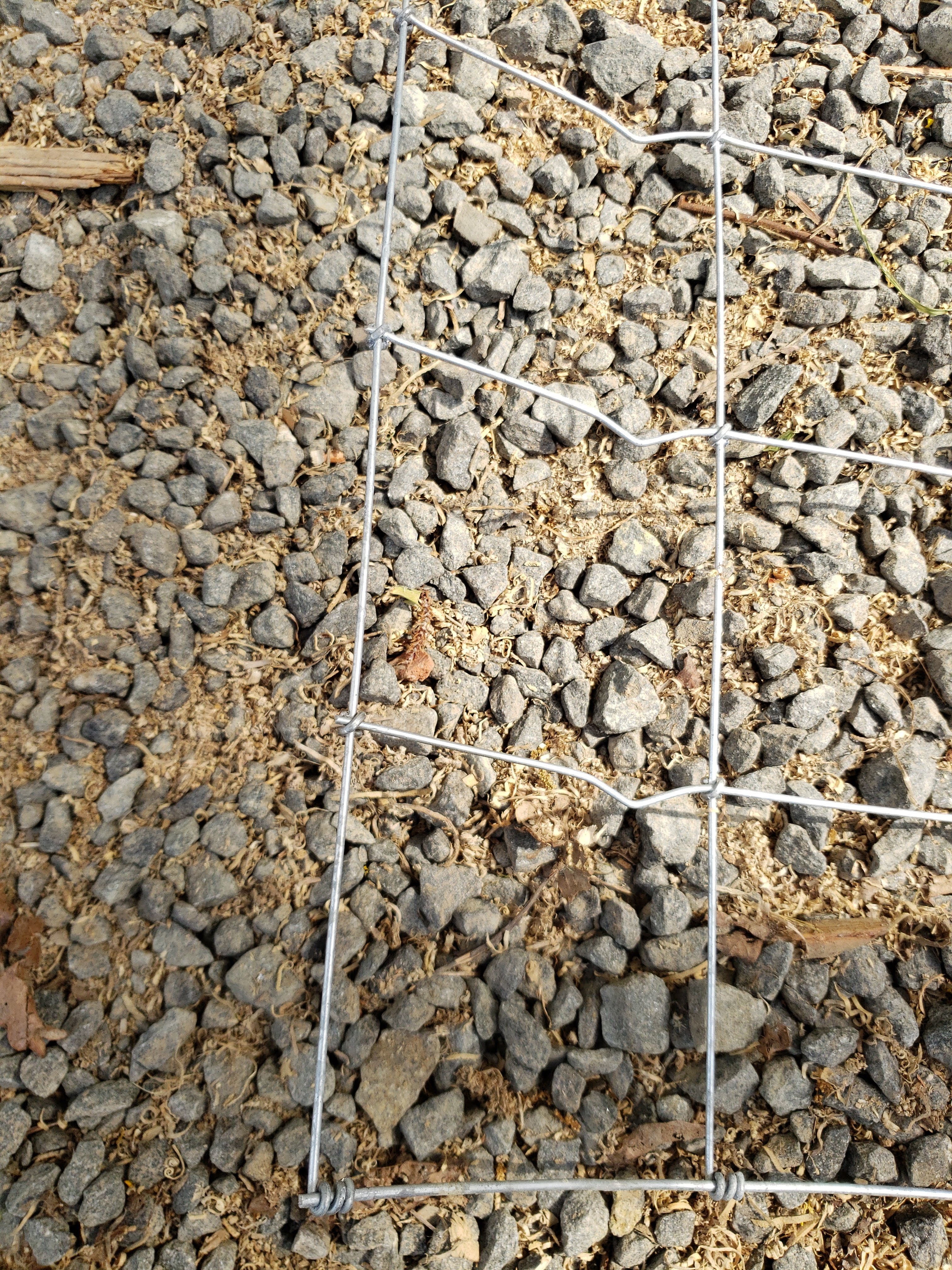
·         One 30m roll of wire mesh will make 10 - 12 circles. Each roll is 1200mm high and the mesh is 100mm square. (I bought a 50m roll at Hollanders in Hobart, to make a good 15 - 18 circles).


·      Cut the roll into 2.5m lengths and join the ends to make circles. You will make 12 circles. So, each circle will be 750mm across, suitable for 1 tomato plant.

Make the cuts right at the edge of the squares to allow the prongs to hook onto the edges


Make sure to twist a couple of prongs right around the flat edge, so the circle does not spring apart when you pick it up!


·        Place all the circles, side by side, wherever your tomatoes will go. This way you can lay it all out and select one bed or several.

·         Move one of the circles aside. Plant your tomato. I push in one tall, curly rod (from Shiploads) in the hole with the tomato but a long bamboo stick would do. In France they are called tomato stakes.

·         Replace the wire circle. Bang in a stake inside the windward side of the circle (or preferably 2, for those unexpected gales from another direction!) Staple the name tag to the top of that stake. Move to the next circle and repeat until all 10 tomatoes are planted.

·         Next, tie all adjacent circles together, to give strength from the wind.

·         Water in your tomatoes.

·         Get a coffee and your camera and share your amazing tomato planting photos!

·         When your tomatoes finish, use the circles for all sorts of other things in the garden. I used all mine up last year so had to go and buy another roll this year!

The books

·         ‘Always Home’ by Fanny Singer….. growing up with Alice Waters for a mother. Fabulous book!

·         ‘Seeds: time capsules of life’ (by Rob Kesseler & Wolfgang Stuppy)…. Like no other book. Beautiful, fascinating.

·         ‘Gardening at the Dragon’s Gate: At work in the wild and cultivated world’ (by Wendy Johnson). Wendy spent 25 years growing food at the Zen buddhist, Green Glulch Farm, near San Francisco. Another incredible, enlightening book.


Jobs for November


Sow indoors to plant out later:

Cucumbers (Lebanese or Dragon’s Egg), zucchinis (Romanesco), tromboncino, corn, pumpkins.

Sow in the garden:

Beans (after frosts), salad leaves (not just lettuce!), brassicas (cover with moth netting), most herbs, salad and spring onions, beetroot, fennel, carrots, celery, parsnip, sunflowers and lots of flowers.

  • Plant out frost tender seedlings, including tomatoes, late Nov.
  • Check your hose fittings, watering cans and irrigation equipment.
  • Share excess seedlings with friends.
  • Most of all, enjoy the garden😊
  • Keep grass under control (good luck!)